Mostrando postagens com marcador Viruses. Mostrar todas as postagens

sábado, 16 de maio de 2015

Macroviruses are BACK and are the future of malware, says Microsoft


It's 2015 and half a million people will still click on stuff we knew was bad in the '90s

30 Apr 2015 at 01:58, Darren Pauli

Macro malware is making a comeback with one nineties nasty infecting half a million computers, Microsoft says.

Macro viruses took a battering over the last decade after Redmond spent a decade boosting security in its Office suites to reduce the likelihood that users would execute malicious macros.

Word processors throw warnings about unknown sources and relegates execution to a manual click-through process by which users would need to all but insist on infecting themselves before macros would run.

"Just when you think macro malware is a thing of the past, over the past few months, we have seen an increasing macro downloader trend that affects nearly 501,240 unique machines worldwide," Redmond's malware boffins say .

"The user opens the document, enables the macro, thinking that the document needs it to function properly – unknowingly enabling the macro malware to run."

The United Kingdom and the US each soak up about a quarter of the total infections, way above the 20,000 p0wned boxes each in France, Italy, and Germany, and blasting the paltry Aussie total of 14,000.

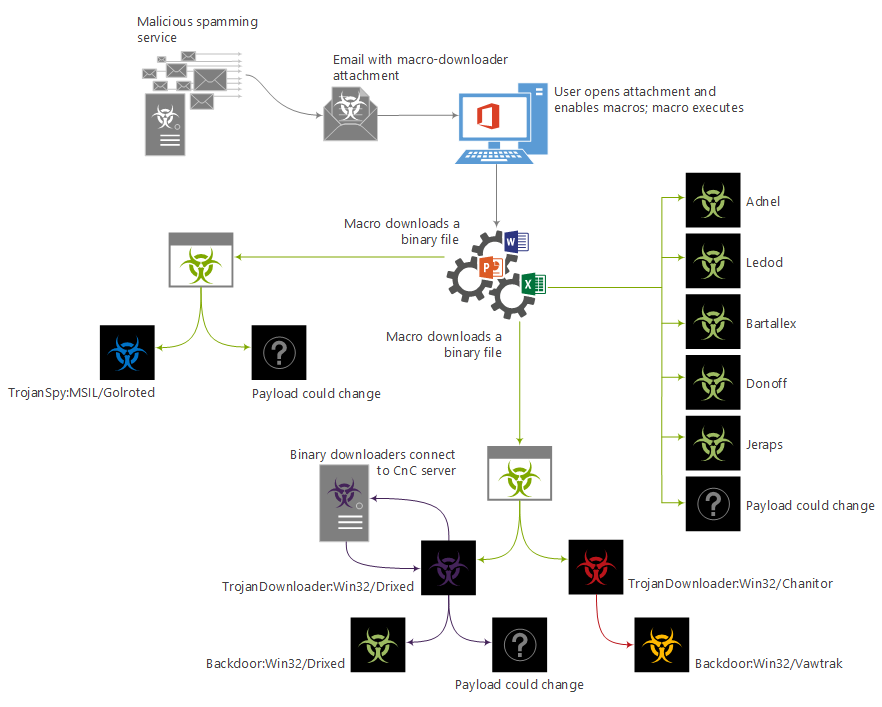
Macro threat flow

Attackers do not appear to have reinvented wheels. Microsoft says they are using documents aimed to pique a victim's interest such as purported sales invoices, tax payments, and courier notifications.

The macro threats include Adnel; Bartallex; Donoff; Jeraps, and Ledod, which fetches trojan payloads or additional downloaders after execution.

"After the macro malware is downloaded, the job is pretty much done. The torch is passed to either the final payload or the binary downloader," Microsoft says.

The company says users should stick to its decade-old advice and avoid executing macros while system administrators can block older versions of Office from executing and ensure security things are up to date.

quinta-feira, 15 de janeiro de 2015

Do viruses make us smarter?


Mon, 01/12/2015 - 10:36am

Lund Univ.

A new study from Lund Univ. in Sweden indicates inherited viruses that are millions of years old play an important role in building up the complex networks that characterize the human brain.

Researchers have long been aware endogenous retroviruses constitute around 5% of our DNA. For many years, they were considered junk DNA of no real use, a side effect of our evolutionary journey.

In the current study, Johan Jakobsson and his colleagues show that retroviruses seem to play a central role in the basic functions of the brain, more specifically in the regulation of which genes are to be expressed, and when. The findings indicate that, over the course of evolution, the viruses took an increasingly firm hold on the steering wheel in our cellular machinery. The reason the viruses are activated specifically in the brain is probably due to the fact tumors can’t form in nerve cells, unlike in other tissues.

“We have been able to observe that these viruses are activated specifically in the brain cells and have an important regulatory role. We believe that the role of retroviruses can contribute to explaining why brain cells in particular are so dynamic and multifaceted in their function. It may also be the case that the viruses’ more or less complex functions in various species can help us to understand why we are so different,” says Jakobsson, head of the research team for molecular neurogenetics at Lund Univ.

The article, based on studies of neural stem cells, shows that these cells use a particular molecular mechanism to control the activation processes of the retroviruses. The findings provide us with a complex insight into the innermost workings of the most basal functions of the nerve cells. At the same time, the results open up potential for new research paths concerning brain diseases linked to genetic factors.

“I believe that this can lead to new, exciting studies on the diseases of the brain. Currently, when we look for genetic factors linked to various diseases, we usually look for the genes we are familiar with, which make up a mere two per cent of the genome. Now we are opening up the possibility of looking at a much larger part of the genetic material which was previously considered unimportant. The image of the brain becomes more complex, but the area in which to search for errors linked to diseases with a genetic component, such as neurodegenerative diseases, psychiatric illness and brain tumors, also increases,” says Jakobsson.

Source: Lund Univ.

sexta-feira, 12 de setembro de 2014

New defense mechanism against viruses discovered


When it comes to defense against viruses, the immune system has an arsenal of weapons at its disposal including killer cells, antibodies and messenger molecules, to name just a few. When a pathogen attacks the body, the immune system usually activates the appropriate mechanisms. However, some of the mechanisms do not have to be triggered; they are continuously active as a standing army. Researchers from ETH Zurich, in collaboration with scientists from the University of Bern, have now discovered a new form of this so-called innate immune defense. They have shown that it acts against particular viruses with a genome in the form of single-stranded, positive-sense RNA. Many known pathogens, such as hepatitis C, tick-borne encephalitis, polio, SARS, yellow fever and dengue fever viruses belong to this group, as well as potyviruses, a group of plant viruses that can cause severe damage to economically important crops.

Researchers led by Ari Helenius, Professor of Biochemistry at ETH Zurich, discovered the mechanism during their research with human cells in cell culture and a model virus that is frequently used in basic research, the Semliki Forest virus. In an extensive screening process, the scientists turned off individual genes inside host cells; they discovered that the cells were more susceptible to infection by the virus if the genes of a cellular quality control and regulatory system for RNA, known as NMD (nonsense-mediated mRNA decay), were turned off.

Viruses identified as incorrect cellular RNA

In a parallel large-scale screening effort, Olivier Voinnet, Professor of RNA Biology at ETH Zurich, and his colleagues realised that this mechanism is also acting against viruses in plants. They used the model plant Arabidopsis thaliana and potato virus X for their investigation. Helenius and Voinnet's groups have published their two research papers on human cells and plants in the latest edition of the journal Cell Host & Microbe -- the former in collaboration with the group of Oliver Mühlemann, a professor at the University of Bern, who has dealt intensively with the NMD system in recent years.

The NMD system has been known for some time in biology as a quality control and regulatory mechanism that eliminates incorrectly fabricated and non-functional messenger RNA molecules in cells. However, the new studies show that this system also serves a second function: It ensures that the genome of certain RNA viruses is broken down, thereby preventing them from replicating in host cells. "The RNA genome of these viruses bears certain similarities to incorrect messenger RNA molecules in human, animal and plant cells and is identified as such by the NMD system," explains Giuseppe Balistreri, post-doctoral fellow and lead author of one of the two studies.

Oldest defense mechanism

The researchers believe that the NMD system provides a first line of defense against infection by this class of viruses. "The mechanism attacks the viral genome directly before it can multiply in the host cell," say both Helenius and Voinnet. The ETH scientists also believe that this is one of the oldest defense mechanisms against viruses in evolutionary history, as the NMD system is so fundamental that it is found in all higher organisms; i.e. people, animals, plants and fungi.

However, the mechanism is not 100 per cent efficient. "If it were, then RNA viruses wouldn't exist at all," says Helenius. Instead, the viruses have evolved ways to avoid or actively suppress the NMD system, as both ETH research groups suggest in their respective studies. "Viruses and their hosts are engaged in an endless battle, of which the NMD system is a previously unsuspected yet significant component," says Voinnet. "In this battle, the NMD mechanism likely contributed to shape the genomes of RNA viruses as we see them today."

Snap 2014-09-12 at 18.10.27


Story Source:

The above story is based on materials provided by ETH Zurich. Note: Materials may be edited for content and length.


Journal References:

  1. Damien Garcia, Shahinez Garcia, Olivier Voinnet. Nonsense-Mediated Decay Serves as a General Viral Restriction Mechanism in Plants. Cell Host & Microbe, 2014; DOI: 10.1016/j.chom.2014.08.001
  2. Giuseppe Balistreri, Peter Horvath, Christoph Schweingruber, David Zünd, Gerald McInerney, Andres Merits, Oliver Mühlemann, Claus Azzalin, Ari Helenius. The Host Nonsense-Mediated mRNA Decay Pathway Restricts Mammalian RNA Virus Replication. Cell Host & Microbe, 2014; 16 (3): 403 DOI: 10.1016/j.chom.2014.08.007