domingo, 7 de dezembro de 2014

World's largest capacity container ship embarks on maiden voyage


The CSCL Globe, shown here on sea trials, has embarked on its maiden voyage (Photo: HHI)

The CSCL Globe, shown here on sea trials, has embarked on its maiden voyage (Photo: HHI)

The world's largest capacity container ship has set off on its maiden voyage. Measuring 400 m (1,312 ft) in length and 58.6 m (192 ft) wide – or the size of four soccer fields for those more familiar with that alternative unit of measurement – the CSCL Globe can carry 19,000 twenty-foot equivalent unit (TEU) shipping containers.

The CSCL Globe was constructed by Hyundai Heavy Industries Co., Ltd (HHI) for China Shipping Container Lines (CSCL) and is the first of five ordered by the Shanghai-based marine shipping company in May last year.

Despite being the same length and 0.4 m (1.3 ft) thinner, the CSCL Globe can carry 730 more TEU than the Maersk Triple E class container ships that have a capacity of 18,270 TEU. This is thanks to the CSCL Globe's extra draft of 30.5 m (100 ft) compared to the Maersk Triple E's 14.5 m (47.5 ft). (Although, both of these fall short of the the monstrous Prelude FLNG.)

In spite of its extra carrying capacity, HHI says the CSCL Globe's 77,200 bhp (56,800 kW) electronically-controlled main engine, which automatically adjusts fuel consumption based on the ship's speed and sea conditions, allows the ship to burn 20 percent less fuel per TEU than ships with 10,000 TEU capacity.

The CSCL Globe set off from Tianjin, China this week, embarking on its first of many voyages on the Asia-Europe trade loop.

Source: Hyundai Heavy Industries


Thin, strong bond for vacuum seal


Thu, 12/04/2014 - 10:09am

Patrick Egan, NIST

Silicate bonds are so thin they are transparent. Image: NIST

Silicate bonds are so thin they are transparent. Image: NISTAn ultra-stable, ultra-thin bonding technology has been adapted by researchers in NIST Physical Measurement Laboratory (PML)’s Semiconductor and Dimensional Metrology Div. for use as a super-strong vacuum seal.

Though it is less than 100 nm thick, the bond can withstand pressure up to 2 megapascals (almost 300 pounds per square inch), and its drift, or how much it shifts over time, is on the order of less than 3 trillionths of a meter per hour. In tests with helium, the bonds show leak rates of less than 10-8 standard cubic centimeters per meter, a performance as good as that of an o-ring seal.

The method, called silicate bonding, had previously been used by other experiments to affix optical materials to one another but its use as a vacuum seal had not been attempted to the researchers’ knowledge.

The team used the technique for their recent prototype of the first photonic pressure sensor, a device that outperformed the present standard, a 3-m-tall mercury-based device, in resolution, speed, and range at a fraction of the size.

Several industry representatives have already shown interest in the prototype pressure sensor, which could be used for semiconductor, glass, and aerospace manufacturing.

Source: NIST

In world first, researchers convert sunlight to electricity with over 40 percent efficiency


December 7, 2014

University of New South Wales

Australia's solar researchers have converted over 40 percent of the sunlight hitting a solar system into electricity, the highest efficiency ever reported. A key part of the prototype's design is the use of a custom optical bandpass filter to capture sunlight that is normally wasted by commercial solar cells on towers and convert it to electricity at a higher efficiency than the solar cells themselves ever could.


Solar panels (stock image).

UNSW Australia's solar researchers have converted over 40% of the sunlight hitting a solar system into electricity, the highest efficiency ever reported.

The record efficiency was achieved in outdoor tests in Sydney, before being independently confirmed by the National Renewable Energy Laboratory (NREL) at their outdoor test facility in the United States.

The work was funded by the Australian Renewable Energy Agency (ARENA) and supported by the Australia-US Institute for Advanced Photovoltaics (AUSIAPV).

"This is the highest efficiency ever reported for sunlight conversion into electricity," UNSW Scientia Professor and Director of the Advanced Centre for Advanced Photovoltaics (ACAP) Professor Martin Green said.

"We used commercial solar cells, but in a new way, so these efficiency improvements are readily accessible to the solar industry," added Dr Mark Keevers, the UNSW solar scientist who managed the project.

The 40% efficiency milestone is the latest in a long line of achievements by UNSW solar researchers spanning four decades. These include the first photovoltaic system to convert sunlight to electricity with over 20% efficiency in 1989, with the new result doubling this performance.

"The new results are based on the use of focused sunlight, and are particularly relevant to photovoltaic power towers being developed in Australia," Professor Green said.

Power towers are being developed by Australian company, RayGen Resources, which provided design and technical support for the high efficiency prototype. Another partner in the research was Spectrolab, a US-based company that provided some of the cells used in the project.

A key part of the prototype's design is the use of a custom optical bandpass filter to capture sunlight that is normally wasted by commercial solar cells on towers and convert it to electricity at a higher efficiency than the solar cells themselves ever could.

Such filters reflect particular wavelengths of light while transmitting others.

ARENA CEO Ivor Frischknecht said the achievement is another world first for Australian research and development and further demonstrates the value of investing in Australia's renewable energy ingenuity.

"We hope to see this home grown innovation take the next steps from prototyping to pilot scale demonstrations. Ultimately, more efficient commercial solar plants will make renewable energy cheaper, increasing its competitiveness."

The 40% efficiency achievement is outlined in a paper expected to be published soon by the Progress in Photovoltaics journal. It will also be presented at the Australian PV Institute's Asia-Pacific Solar Research Conference, which begins at UNSW Monday, December 8.


Story Source:

The above story is based on materials provided by University of New South Wales. Note: Materials may be edited for content and length.


Promising compound rapidly eliminates malaria parasite


A new report says that the rapid action of (+)-SJ733 will likely slow malaria drug resistance.

An international research collaborative has determined that a promising anti-malarial compound tricks the immune system to rapidly destroy red blood cells infected with the malaria parasite but leave healthy cells unharmed. St. Jude Children's Research Hospital scientists led the study, which appears in the current online early edition of the Proceedings of the National Academy of Sciences (PNAS).

The compound, (+)-SJ733, was developed from a molecule identified in a previous St. Jude-led study that helped to jumpstart worldwide anti-malarial drug development efforts. Malaria is caused by a parasite spread through the bite of an infected mosquito. The disease remains a major health threat to more than half the world's population, particularly children. The World Health Organization estimates that in Africa a child dies of malaria every minute.

In this study, researchers determined that (+)-SJ733 uses a novel mechanism to kill the parasite by recruiting the immune system to eliminate malaria-infected red blood cells. In a mouse model of malaria, a single dose of (+)-SJ733 killed 80 percent of malaria parasites within 24 hours. After 48 hours the parasite was undetectable.

Planning has begun for safety trials of the compound in healthy adults.

Laboratory evidence suggests that the compound's speed and mode of action work together to slow and suppress development of drug-resistant parasites. Drug resistance has long undermined efforts to treat and block malaria transmission.

"Our goal is to develop an affordable, fast-acting combination therapy that cures malaria with a single dose," said corresponding author R. Kiplin Guy, Ph.D., chair of the St. Jude Department of Chemical Biology and Therapeutics. "These results indicate that SJ733 and other compounds that act in a similar fashion are highly attractive additions to the global malaria eradication campaign, which would mean so much for the world's children, who are central to the mission of St. Jude."

Whole genome sequencing of the Plasmodium falciparum, the deadliest of the malaria parasites, revealed that (+)-SJ733 disrupted activity of the ATP4 protein in the parasites. The protein functions as a pump that the parasites depend on to maintain the proper sodium balance by removing excess sodium.

The sequencing effort was led by co-author Joseph DeRisi, Ph.D., a Howard Hughes Medical Institute investigator and chair of the University of California, San Francisco Department of Biochemistry and Biophysics. Investigators used the laboratory technique to determine the makeup of the DNA molecule in different strains of the malaria parasite.

Researchers showed that inhibiting ATP4 triggered a series of changes in malaria-infected red blood cells that marked them for destruction by the immune system. The infected cells changed shape and shrank in size. They also became more rigid and exhibited other alterations typical of aging red blood cells. The immune system responded using the same mechanism the body relies on to rid itself of aging red blood cells.

Another promising class of antimalarial compounds triggered the same changes in red blood cells infected with the malaria parasite, researchers reported. The drugs, called spiroindolones, also target the ATP4 protein. The drugs include NITD246, which is already in clinical trials for treatment of malaria. Those trials involve investigators at other institutions.

"The data suggest that compounds targeting ATP4 induce physical changes in the infected red blood cells that allow the immune system or erythrocyte quality control mechanisms to recognize and rapidly eliminate infected cells," DeRisi said. "This rapid clearance response depends on the presence of both the parasite and the investigational drug. That is important because it leaves uninfected red blood cells, also known as erythrocytes, unharmed."

Laboratory evidence also suggests that the mechanism will slow and suppress development of drug-resistant strains of the parasite, researchers said.

Planning has begun to move (+)-SJ733 from the laboratory into the clinic beginning with a safety study of the drug in healthy adults. The drug development effort is being led by a consortium that includes scientists at St. Jude, the Swiss-based non-profit Medicines for Malaria Venture and Eisai Co., a Japanese pharmaceutical company.


Story Source:

The above story is based on materials provided by St. Jude Children's Research Hospital. Note: Materials may be edited for content and length.


Journal Reference:

  1. María Belén Jiménez-Díaz, Daniel Ebert, Yandira Salinas, Anupam Pradhan, Adele M. Lehane, Marie-Eve Myrand-Lapierre, Kathleen G. O’Loughlin, David M. Shackleford, Mariana Justino de Almeida, Angela K. Carrillo, Julie A. Clark, Adelaide S. M. Dennis, Jonathon Diep, Xiaoyan Deng, Sandra Duffy, Aaron N. Endsley, Greg Fedewa, W. Armand Guiguemde, María G. Gómez, Gloria Holbrook, Jeremy Horst, Charles C. Kim, Jian Liu, Marcus C. S. Lee, Amy Matheny, María Santos Martínez, Gregory Miller, Ane Rodríguez-Alejandre, Laura Sanz, Martina Sigal, Natalie J. Spillman, Philip D. Stein, Zheng Wang, Fangyi Zhu, David Waterson, Spencer Knapp, Anang Shelat, Vicky M. Avery, David A. Fidock, Francisco-Javier Gamo, Susan A. Charman, Jon C. Mirsalis, Hongshen Ma, Santiago Ferrer, Kiaran Kirk, Iñigo Angulo-Barturen, Dennis E. Kyle, Joseph L. DeRisi, David M. Floyd, R. Kiplin Guy. ( )-SJ733, a clinical candidate for malaria that acts through ATP4 to induce rapid host-mediated clearance ofPlasmodium. Proceedings of the National Academy of Sciences, 2014; 201414221 DOI: 10.1073/pnas.1414221111


How the World Can Fight Global Warming, No Matter What Happens in Lima


By David Biello | December 2, 2014

The views expressed are those of the author and are not necessarily those of Scientific American.


Imagine if the world’s two largest polluters unilaterally decide to cut emissions of carbon dioxide, the ubiquitous gas responsible for the bulk of global warming. At the same time, a major developing country admits that future growth will have to be balanced with CO2 pollution limits. Meanwhile, an industrialized nation country takes responsibility for the layer of greenhouse gases it has already added to the atmosphere.

obama-arrives-beijing

Official White House Photo by Chuck Kennedy

Even better, alternatives to burning fossil fuels to generate electricity or propel vehicles get cheap and begin to be deployed at significant scale. The clearing and cutting of the world’s forests slows. Even farmers who don’t particularly believe in climate change begin to take steps to restore carbon to depleted soils to boost fertility.

That’s what significant action to combat climate change would look like. And that’s exactly what is happening in the world right now.

No matter what comes out of the traveling circus known as the Conference of the Parties to the United Nations Framework Convention on Climate Change in Lima, Peru over the next few weeks, nations are taking action to curb global warming on their own. And by the end of the meeting in Lima, the world should be well on its way to delivering national commitments for combating climate change.

Of course, it’s not all good news. Japan’s pollution has risen anew thanks to the shutdown of nuclear reactors in the wake of the Fukushima meltdowns. Canada has repudiated its commitments under the Kyoto Protocol and seems content to let pollution rise as much and as fast as possible, perhaps because a warmer Arctic might let it find yet more tar sands and other natural resources (not unlike seemingly pro-global warming Russia). And Australia has seen its pollution swell with the repeal of its carbon tax.

global-co2-trend

Courtesy of Oak Ridge National Laboratory

Decades of delay mean hopes of restraining global warming to less than 2 degrees Celsius or limiting CO2 concentrations in the atmosphere to less than 450 parts-per-million may seem a little unrealistic. In fact, if the world can only add roughly 1 trillion metric tons of carbon to the atmosphere as has been suggested by scientists, then half has already been burned and the rest could go up in smoke in the next few decades. The world still gets 80 percent of all its energy from burning fossil fuels. No wonder geoengineering—the deliberate manipulation of the planet’s climate by sucking CO2 back out of the air or blocking sunlight—has begun to be suggested as a backup plan.

carbon-countdown

Courtesy of Climate Nexus

Yet, there is still hope. The world’s biggest polluter—China—will attempt to reach a peak in its voluminous output of greenhouse gases by 2030 under the terms of a new agreement with the U.S., and not a peak that is the size of the Himalayas on its borders. Under that same agreement, the U.S. will attempt to cut its CO2 pollution by as much as 28 percent by 2025. The European Union rounds out the world’s biggest industrial polluters by committing to a 40 percent cut by 2030.

Electricity generated by the wind and sun has boomed in recent years, as has the hydropower from dams. China is building more nuclear power plants instead of coal-fired ones—and has pledged to increase such low-carbon energy to 20 percent of its supply by 2030. A shift to less CO2-intensive natural gas is pushing aside dirtier oil and coal while increasing energy efficiency means more heating, cooling, motion and light without as much growth in burning fossil fuels. Slowly but surely CO2 capture and storage is beginning to be tried on power plants and other big pollution sources.

At every level—individuals, families, cities, states, provinces, even multinational corporations—efforts to cut CO2 are underway, ranging from planting street trees to a bid to replace palm oil from deforested bits of Indonesia. That deforestation has helped push Indonesia into the unfortunate position of being the world’s third largest greenhouse gas polluter at times. At the same time, Brazil has slowed its clearing of the Amazon rainforest.

These are still small steps, and so far inadequate to the scale of the challenge ahead, which involves reaching zero pollution before the end of the 21st century.

global-energy-change

Courtesy of Carbon Brief

But these are first steps and they are coming at a quickening pace, which suggest a possible future free of catastrophic climate change. More and faster should be the new slogan for action to address global warming. How much more and how much faster should be the only issue for negotiation. When assessing the news from Lima, keep in mind that the international process does not encompass all the progress made to combat climate change to date.

source of this article :www.scientificamerican.com

sábado, 6 de dezembro de 2014

New technique offers spray-on solar power


It may look more like Junk Yard Wars than high-tech, but U of T researcher Illan Kramer's (pictured) device is the first step towards spray-on solar cells.

Pretty soon, powering your tablet could be as simple as wrapping it in cling wrap.

That's Illan Kramer's (ECE) hope. Kramer and colleagues have just invented a new way to spray solar cells onto flexible surfaces using miniscule light-sensitive materials known as colloidal quantum dots (CQDs) -- a major step toward making spray-on solar cells easy and cheap to manufacture.

"My dream is that one day you'll have two technicians with Ghostbusters backpacks come to your house and spray your roof," said Kramer, a post-doctoral fellow with The Edward S. Rogers Sr. Department of Electrical & Computer Engineering at the University of Toronto and IBM Canada's Research and Development Centre.

Solar-sensitive CQDs printed onto a flexible film could be used to coat all kinds of weirdly shaped surfaces, from patio furniture to an airplane's wing. A surface the size of your car's roof wrapped with CQD-coated film would produce enough energy to power three 100-Watt light bulbs -- or 24 compact fluorescents.

He calls his system sprayLD, a play on the manufacturing process called ALD, short for atomic layer deposition, in which materials are laid down on a surface one atom-thickness at a time.

Until now, it was only possible to incorporate light-sensitive CQDs onto surfaces through batch processing -- an inefficient, slow and expensive assembly-line approach to chemical coating. SprayLD blasts a liquid containing CQDs directly onto flexible surfaces, such as film or plastic, like printing a newspaper by applying ink onto a roll of paper. This roll-to-roll coating method makes incorporating solar cells into existing manufacturing processes much simpler. In two recent papers in the journals Advanced Materials and Applied Physics Letters, Kramer showed that the sprayLD method can be used on flexible materials without any major loss in solar-cell efficiency.

Kramer built his sprayLD device using parts that are readily available and rather affordable -- he sourced a spray nozzle used in steel mills to cool steel with a fine mist of water, and a few regular air brushes from an art store.

"This is something you can build in a Junkyard Wars fashion, which is basically how we did it," said Kramer. "We think of this as a no-compromise solution for shifting from batch processing to roll-to-roll."

"As quantum dot solar technology advances rapidly in performance, it's important to determine how to scale them and make this new class of solar technologies manufacturable," said Professor Ted Sargent (ECE), vice dean, research in the Faculty of Applied Science & Engineering at University of Toronto and Kramer's supervisor. "We were thrilled when this attractively manufacturable spray-coating process also led to superior performance devices showing improved control and purity."

In a third paper in the journal ACS Nano, Kramer and his colleagues used IBM's BlueGeneQ supercomputer to model how and why the sprayed CQDs perform just as well as -- and in some cases better than -- their batch-processed counterparts. This work was supported by the IBM Canada Research and Development Centre, and by King Abdullah University of Science and Technology.

Diamond Magnetometer Breaks Sensitivity Records


Diamonds are a physicist’s best friend–when it comes to measuring the tiniest magnetic fields.

Back in 1896, a young physicist called Pieter Zeeman was fired for carrying out an experiment against the specific wishes of his laboratory supervisor. Despite the consequences, the experiment led to a remarkable discovery that changed Zeeman’s life.

The experiment involved measuring the light emitted by elements placed in a powerful magnetic field. When he did this, Zeeman discovered that the spectral lines were split by the field. In 1902, he was awarded the Nobel Prize in physics for this discovery which is now known as the Zeeman effect.

It is particularly useful for measuring magnetic fields at a distance. For example, astrophysicists use it to map variations in the magnetic field on the sun. But it can also be used to measure fields on a much smaller scale. In theory, the effect could be used to observe the influence of a magnetic field on a single atom.

While they have not got quite this far, Thomas Wolf at the University of Stuttgart in Germany and a few pals, have come pretty close. These guys have used the spectra from nitrogen atoms embedded in diamond to build perhaps the most sensitive magnetometer ever made. They say their new device could soon be capable of measuring the magnetic field associated with protons.

First, some background about magnetometers. In recent years, physicists have made increasingly sensitive magnetometers using a variety of different techniques. One problem they all come up against is that magnetic fields decay very quickly with distance, as 1/r^3.

That means the size of the sensor has an important impact on what it can detect, since magnetic field can change significantly throughout the volume of the sensor. So an important task is to make magnetometers as small as possible.

That’s where diamond comes in. Diamond is a three-dimensional crystal made of carbon. However, when a carbon atom in the structure is replaced with nitrogen, this produces an additional unbound electron.

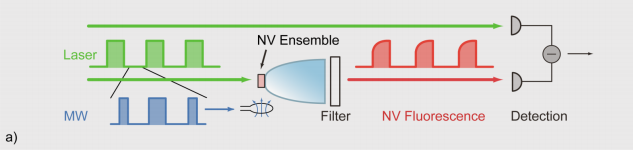
When this electron is excited with laser light, it then fluoresces at a frequency that depends on its environment. A magnetic field in particular can change this frequency, via the Zeeman effect, making nitrogen defects in diamond a promising type of magnetometer.

Of course, addressing a single atom in such a structure and recording its fluorescence accurately is a tricky business. So Wolf and co use an entire ensemble of nitrogen defects in a volume of diamond occupying just a fraction of a cubic millimetre. They estimate that this contains several billion nitrogen atoms.

Although a centre of this size is many orders of magnitude larger than an individual atom, it produces a fluorescent signal that is much easier to measure. That makes the device practical. Even at this size, the magnetometer is one of the smallest ever made.

To find out how sensitive, Wolf and co put the device through its paces, carefully eliminating noise at every step. The results are impressive. The team eventually measured a field strength of only 100 femtoTesla.  That’s comparable with the most sensitive magnetometers on the planet. And they think they can do even better with relatively straightforward improvements that should increase the sensitivity by two orders of magnitude.

But here’s the thing: what’s unique about this device is that it is both small and sensitive, a combination that has never been achieved before. That makes this device a kind of record breaker. It can measure magnetic field strengths in tiny volumes that have never been accessible before. In other words, it opens up magnetic field strength detection on an entirely new scale using a solid state device that works at room temperature.

One goal in this area is to measure the magnetic fields of protons in water. The sensitivity of this device looks to make this possible. “This value itself allows for detection of proton spins in a microscopically resolvable volume in less than one second,” says Wolf and co.

Magnetometers are used in a wide range of applications, ranging from mineral exploration and archaeology to weapon systems positioning and heartbeat monitors. So a robust, highly sensitive solid-state device that works at room temperature is likely to come in handy. Zeeman would have been impressed.

Ref: arxiv.org/abs/1411.6553  A Subpicotesla Diamond Magnetometer

Computers that teach by example: New computer system enables pattern-recognition systems to convey what they learn to humans


Computers are good at identifying patterns in huge data sets. Humans, by contrast, are good at inferring patterns from just a few examples.

In a paper appearing at the Neural Information Processing Society's conference next week, MIT researchers present a new system that bridges these two ways of processing information, so that humans and computers can collaborate to make better decisions.

The system learns to make judgments by crunching data but distills what it learns into simple examples. In experiments, human subjects using the system were more than 20 percent better at classification tasks than those using a similar system based on existing algorithms.

"In this work, we were looking at whether we could augment a machine-learning technique so that it supported people in performing recognition-primed decision-making," says Julie Shah, an assistant professor of aeronautics and astronautics at MIT and a co-author on the new paper. "That's the type of decision-making people do when they make tactical decisions -- like in fire crews or field operations. When they're presented with a new scenario, they don't do search the way machines do. They try to match their current scenario with examples from their previous experience, and then they think, 'OK, that worked in a previous scenario,' and they adapt it to the new scenario."

In particular, Shah and her colleagues -- her student Been Kim, whose PhD thesis is the basis of the new paper, and Cynthia Rudin, an associate professor of statistics at the MIT Sloan School of Management -- were trying to augment a type of machine learning known as "unsupervised."

In supervised machine learning, a computer is fed a slew of training data that's been labeled by humans and tries to find correlations -- say, those visual features that occur most frequently in images labeled "car." In unsupervised machine learning, on the other hand, the computer simply looks for commonalities in unstructured data. The result is a set of data clusters whose members are in some way related, but it may not be obvious how.

Balancing act

The most common example of unsupervised machine learning is what's known as topic modeling, in which a system clusters documents together according to their most characteristic words. Since the data is unlabeled, the system can't actually deduce the topics of the documents. But a human reviewing its output would conclude that, for instance, the documents typified by the words "jurisprudence" and "appellate" are legal documents, while those typified by "tonality" and "harmony" are music-theory papers.

The MIT researchers made two major modifications to the type of algorithm commonly used in unsupervised learning. The first is that the clustering was based not only on data items' shared features, but also on their similarity to some representative example, which the researchers dubbed a "prototype."

The other is that rather than simply ranking shared features according to importance, the way a topic-modeling algorithm might, the new algorithm tries to winnow the list of features down to a representative set, which the researchers dubbed a "subspace." To that end, the algorithm imposes a penalty on subspaces that grow too large. So when it's creating its data clusters, it has to balance three sometimes-competing objectives: similarity to prototype, subspace size, and clear demarcations between clusters.

"You have to pick a good prototype to describe a good subspace," Kim explains. "At the same time, you have to pick the right subspace such that the prototype makes sense. So you're doing it all simultaneously."

The researchers' first step was to test their new algorithm on a few classic machine-learning tasks, to make sure that the added constraints didn't impair its performance. They found that on most tasks, it performed as well as its precursor, and on a few, it actually performed better. Shah believes that that could be because the prototype constraint prevents the algorithm from assembling feature lists that contain internal contradictions.

Suppose, for instance, that an unsupervised-learning algorithm was trying to characterize voters in a population. A plurality of the voters might be registered as Democrats, but a plurality of Republicans may have voted in the last primary. The conventional algorithm might then describe the typical voter as a registered Democrat who voted in the last Republican primary. The prototype constraint makes that kind of result very unlikely, since no single voter would match its characterization.

Road test

Next, the researchers conducted a set of experiments to determine whether prototype-based machine learning could actually improve human decision-making. Kim culled a set of recipes from an online database in which they had already been assigned categories -- such as chili, pasta, and brownies -- and distilled them to just their ingredient lists. Then she fed the lists to both a conventional topic-modeling algorithm and the new, prototype-constrained algorithm.

For each category, the new algorithm found a representative example, while the conventional algorithm produced a list of commonly occurring ingredients. Twenty-four subjects were then given 16 new ingredient lists each. Some of the lists were generated by the new algorithm and some by the conventional algorithm, and the assignment was random. With lists produced by the new algorithm, subjects were successful 86 percent of the time, while with lists produced by the conventional algorithm, they were successful 71 percent of the time.

"I think this is a great idea that models the machine learning and the interface with users appropriately," says Ashutosh Saxena, an assistant professor of computer science at Cornell University. Saxena leads a research project called Robo Brain, which uses machine learning to comb the Internet and model the type of common-sense associations that a robot would need to navigate its environment.

"In Robo Brain, the machine-learning algorithm is trying to learn something, and it may not be able to do things properly, so it has to show what it has learned to the users to get some feedback so that it can improve its learning," Saxena says. "We would be very interested in using such a technique to show the output of Robo Brain project to users."

45-year physics mystery shows a path to quantum transistors


Samarium hexaboride, abbreviated SmB6, is a compound made of the metal samarium and the rare metalloid boron. University of Michigan researchers have confirmed its unusual electrical properties and shown how it could advance the development of next-generation transistors for quantum computers.

An odd, iridescent material that's puzzled physicists for decades turns out to be an exotic state of matter that could open a new path to quantum computers and other next-generation electronics.

Physicists at the University of Michigan have discovered or confirmed several properties of the compound samarium hexaboride that raise hopes for finding the silicon of the quantum era. They say their results also close the case of how to classify the material--a mystery that has been investigated since the late 1960s.

The researchers provide the first direct evidence that samarium hexaboride, abbreviated SmB6, is a topological insulator. Topological insulators are, to physicists, an exciting class of solids that conduct electricity like a metal across their surface, but block the flow of current like rubber through their interior. They behave in this two-faced way despite that their chemical composition is the same throughout.

The U-M scientists used a technique called torque magnetometry to observe tell-tale oscillations in the material's response to a magnetic field that reveal how electric current moves through it. Their technique also showed that the surface of samarium hexaboride holds rare Dirac electrons, particles with the potential to help researchers overcome one of the biggest hurdles in quantum computing.

These properties are particularly enticing to scientists because SmB6 is considered a strongly correlated material. Its electrons interact more closely with one another than most solids. This helps its interior maintain electricity-blocking behavior.

This deeper understanding of samarium hexaboride raises the possibility that engineers might one day route the flow of electric current in quantum computers like they do on silicon in conventional electronics, said Lu Li, assistant professor of physics in the College of Literature, Science, and the Arts and a co-author of a paper on the findings published in Science.

"Before this, no one had found Dirac electrons in a strongly correlated material," Li said. "We thought strong correlation would hurt them, but now we know it doesn't. While I don't think this material is the answer, now we know that this combination of properties is possible and we can look for other candidates."

The drawback of samarium hexaboride is that the researchers only observed these behaviors at ultracold temperatures.

Quantum computers use particles like atoms or electrons to perform processing and memory tasks. They could offer dramatic increases in computing power due to their ability to carry out scores of calculations at once. Because they could factor numbers much faster than conventional computers, they would greatly improve computer security.

In quantum computers, "qubits" stand in for the 0s and 1s of conventional computers' binary code. While a conventional bit can be either a 0 or a 1, a qubit could be both at the same time--only until you measure it, that is. Measuring a quantum system forces it to pick one state, which eliminates its main advantage.

Dirac electrons, named after the English physicist whose equations describe their behavior, straddle the realms of classical and quantum physics, Li said. Working together with other materials, they could be capable of clumping together into a new kind of qubit that would change the properties of a material in a way that could be measured indirectly, without the qubit sensing it. The qubit could remain in both states.

While these applications are intriguing, the researchers are most enthusiastic about the fundamental science they've uncovered.

"In the science business you have concepts that tell you it should be this or that and when it's two things at once, that's a sign you have something interesting to find," said Jim Allen, an emeritus professor of physics who studied samarium hexaboride for 30 years. "Mysteries are always intriguing to people who do curiosity-driven research."

Allen thought for years that samarium hexaboride must be a flawed insulator that behaved like a metal at low temperatures because of defects and impurities, but he couldn't align that with all of its other properties.

"The prediction several years ago about it being a topological insulator makes a lightbulb go off if you're an old guy like me and you've been living with this stuff your whole life," Allen said.

In 2010, Kai Sun, assistant professor of physics at U-M, led a group that first posited that SmB6 might be a topological insulator. He and Allen were also involved in seminal U-M experiments led by physics professor Cagliyan Kurdak in 2012 that showed indirectly that the hypothesis was correct.

"But the scientific community is always critical," Sun said. "They want very strong evidence. We think this experiment finally provides direct proof of our theory."

Chemicals released during natural gas extraction may harm reproduction, development


December 5, 2014

University of Missouri-Columbia

Unconventional oil and gas operations combine directional drilling and hydraulic fracturing to release natural gas from rock. Discussions have centered on potential air and water pollution from chemicals and how they affect the more than 15 million Americans living within one mile of UOG operations. Now, a researcher has conducted the largest review of research centered on fracking byproducts and their effects on human reproductive and developmental health.


Unconventional oil and gas (UOG) operations combine directional drilling and hydraulic fracturing, or "fracking," to release natural gas from underground rock. Recent discussions have centered on potential air and water pollution from chemicals used in these processes and how it affects the more than 15 million Americans living within one mile of UOG operations. Now, Susan C. Nagel, a researcher with the University of Missouri, and national colleagues have conducted the largest review to date of research centered on fracking byproducts and their effects on human reproductive and developmental health. They determined that exposure to chemicals released in fracturing may be harmful to human health in men, women and children and recommend further scientific study.

"We examined more than 150 peer-reviewed studies reporting on the effects of chemicals used in UOG operations and found evidence to suggest there is cause for concern for human health," said Nagel. "Further, we found that previous studies suggest that adult and early life exposure to chemicals associated with UOG operations can result in adverse reproductive health and developmental defects in humans."

The "weight of evidence" review of scientific literature and peer-reviewed publications, where studies are examined thoroughly for patterns and links, included international studies that focused on UOG chemicals. Reviewers say these chemicals have been measured in air and water near UOG operations, and have been associated with harmful effects in both animals and humans.

The reviewers concluded that exposure to air and water pollution caused by UOG operations may be linked to health concerns including infertility, miscarriage, impaired fetal growth, birth defects and reduced semen quality.

"There are far fewer human studies than animal studies; however, taken together, the studies did show that humans can be harmed by these chemicals released from fracking," Nagel said. "There is strong evidence of decreased semen quality in men, higher miscarriages in women and increased risk of birth defects in children. There is a striking need for continued research on UOG processes and chemicals and the health outcomes in people."

Nagel, an associate professor of obstetrics, gynecology and women's health in the School of Medicine, and adjunct associate professor of biological sciences in the College of Arts and Science at MU, conducted the review with colleagues from the University of Missouri as well as researchers at the Institute for Health and the Environment and the Center for Environmental Health.


Story Source:

The above story is based on materials provided by University of Missouri-Columbia. Note: Materials may be edited for content and length.


Journal Reference:

  1. Ellen Webb, Sheila Bushkin-Bedient, Amanda Cheng, Christopher D. Kassotis, Victoria Balise, Susan C. Nagel. Developmental and reproductive effects of chemicals associated with unconventional oil and natural gas operations. Reviews on Environmental Health, 2014; 29 (4) DOI: 10.1515/reveh-2014-0057