Mostrando postagens com marcador Magnetism. Mostrar todas as postagens

quinta-feira, 2 de julho de 2015

Evidence for stable room-temperature skyrmions found


Thu, 07/02/2015 - 10:17am

RIKEN

In research published in Nature Communications, researchers from the RIKEN Center for Emergent Matter Science in Japan, along with collaborators in Europe and Japan, have identified a class of materials that displays clear evidence for stable skyrmions at room temperature and above, paving the way for the development of useful spintronics devices.

Magnetic skyrmions are tiny, nanometer-sized magnetic-spin vortices that emerge in magnetic materials. Because they are so small, they could potentially be used as extremely dense memory devices, with the presence or absence of skyrmions being used to denote bits in computer calculations. Achieving this could lead to the advent of a new class of low-power-consumption devices dubbed "spintronics", which include high-density magnetic memory.

However, skyrmions are not always easy to use. Though they occur ubiquitously in magnets, in a diverse range of circumstances, they are not always easy to control. The ultimate dream of researchers has been to create stable skyrmions—which do not decay—in a set chirality, so that their presence or absence can be manipulated to represent data for storage devices.

Skyrmions emerging from a process called the Dzyaloshinskii-Moriya interaction have been considered to be particularly promising, as they are small (under 150 nanometers) and have a fixed direction of spin. As a result, they could host a large number of stable skyrmions which could be manipulated by electrical currents, and hence could be used to create high-density storage. Such stable skyrmions have been found in certain crystal structures, but in the materials studied so far, such as MnSi and Cu2OSeO3, the skyrmions emerge most strongly in low temperatures, requiring low-temperature manipulation.

For the present study, the scientists decided to look at a type of magnetic material made up of cobalt, zinc, and manganese, whose structure seemed likely to host stable skyrmions. Using a variety of techniques, they were able to show indeed that when a magnetic field was applied, the material showed the clear presence of skyrmion crystals in both a bulk shape and when shaped into a thin plate. These skyrmions were both stable and chiral—meaning that they spun in a set direction—so that they could be manipulated to encode information.

According to Yusuke Tokunaga of CEMS, who is the first author of the work, "We are quite excited about these results, as they may answer the long-held expectation that we can find skyrmion hosting systems in a variety of new materials. In addition, the fact that we have shown that skyrmions can be stabilized at room temperature and above opens the road to looking for ways to integrate skyrmions into spintronics devices without complicated cooling systems."

The research was done by CEMS scientists in collaboration with scientists from the Paul Scherrer Institut and Ecole Polytechnique Federale de Lausanne in Switzerland and the University of Tokyo in Japan.

SOURCE: RIKEN

quarta-feira, 3 de junho de 2015

Understanding a new kind of magnetism


Understanding a new kind of magnetism

A sample of the mineral herbertsmithite. Credit: ROB LAVINSKY/IROCKS.COM

Using low-frequency laser pulses, a team of researchers has carried out the first measurements that reveal the detailed characteristics of a unique kind of magnetism found in a mineral called herbertsmithite.

In this material, the magnetic elements constantly fluctuate, leading to an exotic state of fluid magnetism called a "quantum spin liquid." This is in contrast to conventional magnetism, found in materials called ferromagnets—where all of the magnetic forces align in the same direction, reinforcing each other—or antiferromagnets, where adjacent magnetic elements align in opposite directions, leading to complete cancellation of the material's overall magnetic field.

Although a spin-liquid state has previously been observed in herbertsmithite, there has never been a detailed analysis of how the material's electrons respond to light—a key to determining which of several competing theories about the material is correct.

Now a team at MIT, Boston College and Harvard University has successfully carried out these measurements. The new analysis is reported in a paper in Physical Review Letters, co-authored by Nuh Gedik, the Biedenharn Career Development Associate Professor of Physics at MIT, graduate student Daniel Pilon, postdoc Chun Hung Lui and four others.

Their measurements, using laser pulses lasting just a trillionth of a second, reveal a signature in the optical conductivity of the spin-liquid state that reflects the influence of magnetism on the motion of electrons. This observation supports a set of theoretical predictions that have not previously been demonstrated experimentally. "We think this is good evidence," Gedik says, "and it can help to settle what has been a pretty big debate in spin-liquid research."

"Theorists have provided a number of theories on how a spin-liquid state could be formed in herbertsmithite," Pilon explains. "But to date there has been no experiment that directly distinguishes among them. We believe that our experiment has provided the first direct evidence for the realization of one of these theoretical models in herbertsmithite."

The concept of quantum spin liquids was first proposed in 1973, but the first direct evidence for such a material was only found within the last few years. The new measurements help to clarify the fundamental characteristics of this exotic system, which is thought to be closely related to the origins of high-temperature superconductivity.

Gedik says, "Although it is hard to predict any potential applications at this stage, basic research on this unusual phase of matter could help us to solve some very complicated problems in physics, particularly high-temperature superconductivity, which might eventually lead to important applications." In addition, Pilon says, "This work might also be useful for the development of quantum computing."

Leon Balents, a professor of physics at the University of California at Santa Barbara who was not involved in this work, says, "If the observed optical conductivity in these measurements is truly intrinsic, it is an important and exciting result, which will be very important in understanding the nature of the spin-liquid state."

Balents adds that further work is needed to confirm this result, but says "this is clearly an exciting and important measurement, which I hope will be pursued further by extending the frequency and magnetic field range in the future."

The paper is titled "Spin-Induced Optical Conductivity in the Spin-Liquid Candidate Herbertsmithite."

Explore further: Physicists make first observation of the pushing pressure of light

More information: prl.aps.org/abstract/PRL/v111/i12/e127401

This story is republished courtesy of MIT News (web.mit.edu/newsoffice/), a popular site that covers news about MIT research, innovation and teaching.


Newly identified 'universal' property of metamagnets may lead to everyday uses


Newly identified ‘universal’ property of metamagnets may lead to everyday uses

Physics professor Bellave Shivaram has discovered a universal law governing the properties of metamagnets. Credit: Dan Addison

(Phys.org) —A new physics discovery made by a University of Virginia-led team may lead to more efficient refrigerators, heat pumps and airport scanners, among many possible uses –perhaps within a decade.

The team of physicists and materials scientists have discovered a universal law governing the magnetic properties of metamagnets – metal alloys that can undergo dramatic increases in magnetization when a small external magnetic field is applied, such as from a permanent magnet or an electromagnet.

The scientists have discovered that the magnetic effect of apparently all metamagnets is that it is non-linear. When these metamagnets are placed in an initial magnetic field and the field is doubled, they more than double in magnetic strength. This is significant because eventually scientists and engineers likely will harness this unique property for a variety of applications, including refrigeration.

"We found that this nonlinear property has the same quantitative behavior in all different types of metamagnets, which is the universal law," said Bellave Shivaram, a University of Virginia professor of physics who led the studies, which were conducted in his lab and using materials synthesized at Argonne National Laboratory in Illinois.

The findings are published in separate papers currently online in the journals Physical Review B: Rapid Communications, and Review of Scientific Instruments.

According to Shivaram, the newly unveiled non-linear property can be exploited in many ways.

"A very useful property of this type of magnetism is in magnetic refrigeration," he said. "Magnetic refrigerators are not commonplace; they still are in the experimental stage. But they could eventually become part of everyday home appliances, from heat pumps to the refrigerators we store food in."

Currently, metamagnets produce efficient cooling only at very low temperatures, using superconducting magnets, making them impractical for general refrigeration.

"With the new discoveries of the properties of metamagnets, they could become part of everyday home appliances within a decade or so," Shivaram said.

Current refrigerators are among the biggest consumers of energy in the home. They include several moving parts, which make them costly to repair, and they can leak fluorocarbons into the atmosphere, which can deplete ozone. Refrigerators of the future, using metamagnets, would have fewer moving parts, would not require refrigerants, and, likely would use less electricity, Shivaram said.

"In these new materials, the magnetism can be cycled on and off, enabling heat to be pumped away in a manner similar to what happens in a heat pump today," Shivaram said. "In today's heat pump, we use pressure to cycle the cooling medium from liquid to vapor phase. In the new magnetic refrigerators we will use a magnetic material and cycle the magnetic field instead."

Another possible application for metamagnets would be, as an example, more effective airport screening devices. Such screeners use harmless terahertz waves to scan through materials. A screener using metamagnets would generate more efficient generation of terahertz waves, Shivaram said, by converting high-powered, low-frequency radio waves into terahertz waves by using the non-linear properties of metamagnets.

"By discovering the properties of these materials we've shown their promise," Shivaram said. "We will figure out future directions and what new materials we should go after for possible uses."

His co-authors on the Physical Review B paper are former U.Va. graduate student Brian Dorsey, materials scientist David Hinks of Argonne National Laboratory and physicist Pradeep Kumar of the University of Florida. This collaborative work is continuing and recently has been augmented with the participation of Vittorio Celli, U.Va. professor emeritus of physics.

www.phys.org

Strong Magnets With Printed Poles Have Endless Engineering Applications


The Brilliant Idea: Magnets printed with multiple poles, opening the door to myriad applications.


magnetic snowboard binding

Snowboard Bindings

Two magnets tightly attract when aligned but repel when twisted more than 45 degrees, easily clicking on and off. Other apps: cycling cleats, pick-proof locks, standard prosthetic-limb fittings.

Spinal Implants

Magnetic discs attract and repel simultaneously, offering friction-free cushioning for bones of the spine. Other apps: bearings for energy-storing flywheels, assembly-line arms.

Idiot-Proof Assembly

Magnets on the joints of furniture or toys click together only when correctly aligned, making Christmas Eve easier for dads everywhere. Other apps: car parts, aircraft machinery.

(Icons by Dogo)

Innovator: Larry Fullerton, Correlated Magnetics Research

Larry Fullerton set out to invent a self-assembling magnetic toy that would fuel his grandchildren's passion for science. Instead, he invented a way to manipulate magnetic fields that redefines one of the fundamental forces of nature.

Fullerton's breakthrough tramples the long-held assumption that magnets have two opposing poles, one on each side. He found that if he used heat to erase a magnetic field, he could then reprogram material to have multiple north and south poles of differing strengths. "People look at magnets as having a north pole and a south pole. That limits your thinking," he says. "I came along from the field of radar and said, 'Hey, that's not a magnet—it's a vector field!'"

To program the magnets, Fullerton invented a device—picture a printer whose head emits 200,000-amp bursts of electricity rather than ink—that creates magnetic pixels he calls "maxels." Using the printer and some vector math, Fullerton is now learning how to produce magnets that exhibit different behaviors. The practical applications appear limitless: from precision switches and a new generation of fasteners to robots that can scale walls without touching them.

www.popularmechanics.com

domingo, 31 de maio de 2015

Researchers prove magnetism can control heat, sound

Fri, 05/29/2015 - 7:47am

Jamie Abel, Ohio Supercomputer Center


A team led by Ohio State's Wolfgang Windl, PhD, used OSC's Oakley Cluster to calculate acoustic phonon movement within an indium-antimonide semiconductor under a magnetic field. Their findings show that phonon amplitude-dependent magnetic moments are induced on the atoms, which change how they vibrate and transport heat. Image: OSU

A team led by Ohio State's Wolfgang Windl, PhD, used OSC's Oakley Cluster to calculate acoustic phonon movement within an indium-antimonide semiconductor under a magnetic field. Their findings show that phonon amplitude-dependent magnetic moments are induced on the atoms, which change how they vibrate and transport heat. Image: OSUPhonons—the elemental particles that transmit both heat and sound—have magnetic properties, according to a landmark study supported by Ohio Supercomputer Center (OSC) services and recently published by a researcher group from The Ohio State Univ.
In Nature Materials, the researchers describe how a magnetic field, roughly the size of a medical MRI, reduced the amount of heat flowing through a semiconductor by 12%. Simulations performed at OSC then identified the reason for it—the magnetic field induces a diamagnetic response in vibrating atoms known as phonons, which changes how they transport heat.

"This adds a new dimension to our understanding of acoustic waves," said Joseph Heremans, PhD, Ohio Eminent Scholar in Nanotechnology and a professor of mechanical engineering at Ohio State whose group performed the experiments. "We've shown that we can steer heat magnetically. With a strong enough magnetic field, we should be able to steer sound waves, too."

People might be surprised enough to learn that heat and sound have anything to do with each other, much less that either can be controlled by magnets, Heremans acknowledged. But both are expressions of the same form of energy, quantum mechanically speaking. So any force that controls one should control the other.
The nature of the effect of the magnetic field initially was not understood and subsequently was investigated through computer simulations performed on OSC's Oakley Cluster by Oscar Restrepo, PhD, a research associate, Nikolas Antolin, a doctoral student, and Wolfgang Windl, PhD, a professor, all of Ohio State's Dept. of Materials Science and Engineering. After painstakingly examining all possible magnetic responses that a non-magnetic material can have to an external field, they found that the effect is due to a diamagnetic response, which exists in all materials. This suggests then that the general effect should be present in any solid.

The implication: in materials such as glass, stone, plastic—materials which are not conventionally magnetic—heat can be controlled magnetically, if you have a powerful enough magnet. This development may have future impacts on new energy production processes.
But, there won't be any practical applications of this discovery any time soon: seven-tesla magnets like the one used in the study don't exist outside of hospitals and laboratories, and a semiconductor made of indium antimonide had to be chilled to -450 F (-268 C)—very close to absolute zero—to make the atoms in the material slow down enough for the phonons' movements to be detectible.

To simulate the experiment, Windl and his computation team employed a quantum mechanical modeling strategy known as density functional theory (DFT). The DFT strategy was used to determine how the electron distribution changed when atoms vibrated with or without magnetic field. The motion of the electrons around their atoms changed in the field, creating diamagnetic moments when phonons were present. These moments then reacted to the field and slowed the heat transport, similar to an eddy current brake in a train.
The simulations were conducted on the Oakley Cluster, an HP/Intel Xeon system with more than 8,300 processor cores to provide researchers with a peak performance of 154 Teraflops--tech-speak for 154 trillion calculations per second. Since atoms can vibrate in many different ways, a large number of simulations were necessary, consuming approximately 1.5 million CPU hours even on a machine as powerful as Oakley. OSC engineers also helped the research team use OSC's high-throughput, parallel file system to handle the immense datasets generated by the DFT model.

"OSC offered us phenomenal support; they supported our compilation and parallel threading issues, helped us troubleshoot hardware issues when they arose due to code demands, and moved us to the Lustre high-performance file system after we jammed their regular file system," said Antolin, who is the expert for high-demand computations in Windl's group.
"Dr. Windl and his team are important OSC clients, and we're always pleased to support their research projects with our hardware, software and staff support services," said David Hudak, PhD, OSC's director of supercomputer services. "With the addition of the Ruby Cluster this past fall and another, much more powerful system upcoming this fall, OSC will continue to offer even larger, faster and more powerful services to support this type of discovery and innovation."
.
 

sexta-feira, 20 de fevereiro de 2015

Flip out ! Noncommital material could make for hypersensitive magnetic field direction detector


Snap 2015-02-20 at 09.37.15

While the mysterious, unseen forces magnets project are now (mostly) well-understood, they can still occasionally surprise us. For instance, thin films of cobalt have been observed to spontaneously switch their poles—something that typically doesn’t happen in the absence of an external magnetic field. Researchers from the CNST and the University of Maryland have measured this phenomenon on the largest scale yet.
Most magnets are “permanent,” meaning a magnetic field of some strength must be applied to reverse their north and south poles. This permanence enables the billions of tiny magnets in computer hard drives to reliably store data. It also allows nanomagnetic sensor technology, for example, in the magnetometers which detect the earth’s magnetic field in smartphone compasses. Making these devices more energy efficient will require magnets which are increasingly sensitive to external influences, such as small magnetic fields. However, as these magnets become more sensitive they also become more unstable, flipping from north to south and back, even with no magnetic field. The researchers mapped out this instability in a film of cobalt, only a few atoms thick, and determined the conditions under which the instability arises.

They hypothesize that the development of magnetic technology will benefit from their continuously flipping cobalt films, which can function as extremely sensitive magnetic test beds. Many proposed devices implement layers of ferromagnetic material which, to be useful, must be controllable by an external influence. According CNST/UMD Postdoctoral Researcher Andy Balk, however, most magnetic materials are too stable to be influenced at all by small interactions, and researchers have no way of knowing if their proposed devices are even close to working. “As an alternative,” Balk says, “we could make a proposed magnetic device from our unstable film. This way, even if the film were influenced only a very small amount we would see, for example, slightly more north flips than south flips, and we would know we are on the right track.”

The measurements were done with video-rate Kerr Interestingly, these fluctuations exhibit scale microscopy, a form of polarized light microscopy invariance—meaning that their behavior is the that can image the fine-grained details of a same regardless of the length scale on which material’s magnetic state. The scientists found they are observed—a property they share the magnetic fluctuations in the thin cobalt film with otherwise unrelated phenomena such as interact with each other; a fluctuation from north earthquakes and crumpling paper. to south will always have a corresponding nearby fluctuation from south to north.

sábado, 6 de dezembro de 2014

Diamond Magnetometer Breaks Sensitivity Records


Diamonds are a physicist’s best friend–when it comes to measuring the tiniest magnetic fields.

Back in 1896, a young physicist called Pieter Zeeman was fired for carrying out an experiment against the specific wishes of his laboratory supervisor. Despite the consequences, the experiment led to a remarkable discovery that changed Zeeman’s life.

The experiment involved measuring the light emitted by elements placed in a powerful magnetic field. When he did this, Zeeman discovered that the spectral lines were split by the field. In 1902, he was awarded the Nobel Prize in physics for this discovery which is now known as the Zeeman effect.

It is particularly useful for measuring magnetic fields at a distance. For example, astrophysicists use it to map variations in the magnetic field on the sun. But it can also be used to measure fields on a much smaller scale. In theory, the effect could be used to observe the influence of a magnetic field on a single atom.

While they have not got quite this far, Thomas Wolf at the University of Stuttgart in Germany and a few pals, have come pretty close. These guys have used the spectra from nitrogen atoms embedded in diamond to build perhaps the most sensitive magnetometer ever made. They say their new device could soon be capable of measuring the magnetic field associated with protons.

First, some background about magnetometers. In recent years, physicists have made increasingly sensitive magnetometers using a variety of different techniques. One problem they all come up against is that magnetic fields decay very quickly with distance, as 1/r^3.

That means the size of the sensor has an important impact on what it can detect, since magnetic field can change significantly throughout the volume of the sensor. So an important task is to make magnetometers as small as possible.

That’s where diamond comes in. Diamond is a three-dimensional crystal made of carbon. However, when a carbon atom in the structure is replaced with nitrogen, this produces an additional unbound electron.

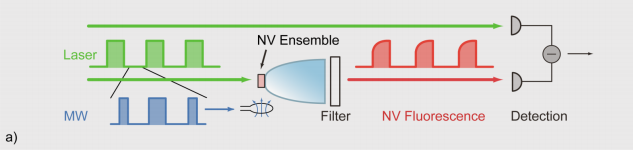
When this electron is excited with laser light, it then fluoresces at a frequency that depends on its environment. A magnetic field in particular can change this frequency, via the Zeeman effect, making nitrogen defects in diamond a promising type of magnetometer.

Of course, addressing a single atom in such a structure and recording its fluorescence accurately is a tricky business. So Wolf and co use an entire ensemble of nitrogen defects in a volume of diamond occupying just a fraction of a cubic millimetre. They estimate that this contains several billion nitrogen atoms.

Although a centre of this size is many orders of magnitude larger than an individual atom, it produces a fluorescent signal that is much easier to measure. That makes the device practical. Even at this size, the magnetometer is one of the smallest ever made.

To find out how sensitive, Wolf and co put the device through its paces, carefully eliminating noise at every step. The results are impressive. The team eventually measured a field strength of only 100 femtoTesla.  That’s comparable with the most sensitive magnetometers on the planet. And they think they can do even better with relatively straightforward improvements that should increase the sensitivity by two orders of magnitude.

But here’s the thing: what’s unique about this device is that it is both small and sensitive, a combination that has never been achieved before. That makes this device a kind of record breaker. It can measure magnetic field strengths in tiny volumes that have never been accessible before. In other words, it opens up magnetic field strength detection on an entirely new scale using a solid state device that works at room temperature.

One goal in this area is to measure the magnetic fields of protons in water. The sensitivity of this device looks to make this possible. “This value itself allows for detection of proton spins in a microscopically resolvable volume in less than one second,” says Wolf and co.

Magnetometers are used in a wide range of applications, ranging from mineral exploration and archaeology to weapon systems positioning and heartbeat monitors. So a robust, highly sensitive solid-state device that works at room temperature is likely to come in handy. Zeeman would have been impressed.

Ref: arxiv.org/abs/1411.6553  A Subpicotesla Diamond Magnetometer

quinta-feira, 19 de junho de 2014

Horizontal levitation: The ultimate solution to particle separation


June 18, 2014

Springer Science+Business Media

Separating particles from the liquid they are in can now be done with a new concept. Magnetic separators exploit the difference in magnetic properties between minerals, for example when separating magnetite from quartz. But this exercise becomes considerably more complex when the particles are not magnetic. In the wake of previous particle levitation experiments under high-power magnetic fields, a new study reveals that particles are deflected away from the magnet's round-shaped bore center in a horizontal direction.


Magnetic separators exploit the difference in magnetic properties between minerals, for example when separating magnetite from quartz. But this exercise becomes considerably more complex when the particles are not magnetic. In the wake of previous particle levitation experiments under high-power magnetic fields, a new study reveals that particles are deflected away from the magnet's round-shaped bore centre in a horizontal direction. Previous studies had observed the vertical levitation of the particles. These findings are presented by Shixiao Liu from the Faculty of Engineering, University of Nottingham, UK and colleagues, in a paper recently published in EPJ E, and could led to a new concept in particles and minerals separation technologies.

The authors analysed video frames covering 0.1 second each of the movement of glass and pyrite particles of roughly one millimetre diameter in a solution that was subjected to a strong non-uniform magnetic field created by a superconducting magnet. The authors show that pyrite and glass particles were deflected and settled at certain positions in a specially designed container. They explain that this pattern is due to differences in the particles' densities and magnetic susceptibilities.

The gradient in the magnetic field gives rise to a radial force-defined by the particles' magnetic properties-capable of separating the glass from pyrite particles. At the same time, the magnetic field gradient also induces the so-called Magneto-Archimedes force, which compensates for the force of gravity. Surprisingly, the particle size seems to have little influence on the results, at least for the limited size range examined in these experiments.

The authors then confirmed their experimental findings using mathematical simulations of the particle displacement.