sábado, 28 de junho de 2014

Not much force: Researchers detect smallest force ever measured


Mechanical oscillators translate an applied force into measureable mechanical motion. The Standard Quantum Limit is imposed by the Heisenberg uncertainty principle, in which the measurement itself perturbs the motion of the oscillator, a phenomenon known as “quantum back-action.”

What is believed to be the smallest force ever measured has been detected by researchers with the Lawrence Berkeley National Laboratory (Berkeley Lab) and the University of California (UC) Berkeley. Using a combination of lasers and a unique optical trapping system that provides a cloud of ultracold atoms, the researchers measured a force of approximately 42 yoctonewtons. A yoctonewton is one septillionth of a newton and there are approximately 3 x 10²³ yoctonewtons in one ounce of force.

"We applied an external force to the center-of-mass motion of an ultracold atom cloud in a high-finesse optical cavity and measured the resulting motion optically," says Dan Stamper-Kurn, a physicist who holds joint appointments with Berkeley Lab's Materials Sciences Division and the UC Berkeley Physics Department. "When the driving force was resonant with the cloud's oscillation frequency, we achieved a sensitivity that is consistent with theoretical predictions and only a factor of four above the Standard Quantum Limit, the most sensitive measurement that can be made."

Stamper-Kurn is the corresponding author of a paper in Science that describes these results. The paper is titled "Optically measuring force near the standard quantum limit." Co-authors are Sydney Schreppler, Nicolas Spethmann, Nathan Brahms, Thierry Botter and Maryrose Barrios.

If you want to confirm the existence of gravitational waves, space-time ripples predicted by Albert Einstein in his theory of general relativity, or want to determine to what extent the law of gravity on the macroscopic scale, as described by Sir Isaac Newton, continues to apply at the microscopic scale, you need to detect and measure forces and motions that are almost incomprehensively tiny. For example, at the Laser Interferometer Gravitational-Wave Observatory (LIGO), scientists are attempting to record motions as small as one thousandth the diameter of a proton.

At the heart of all ultrasensitive detectors of force are mechanical oscillators, systems for translating an applied force into measureable mechanical motion. As measurements of force and motion reach quantum levels in sensitivity, however, they bump up against a barrier imposed by the Heisenberg uncertainty principle, in which the measurement itself perturbs the motion of the oscillator, a phenomenon known as "quantum back-action." This barrier is called the Standard Quantum Limit (SQL). Over the past couple of decades, a wide array of strategies have been deployed to minimize quantum back-action and get ever closer to the SQL, but the best of these techniques fell short by six to eight orders of magnitude.

"We measured force with a sensitivity that is the closest ever to the SQL," says Sydney Schreppler, a member of the Stamper-Kurn research group and lead author of the Science paper. "We were able to achieve this sensitivity because our mechanical oscillator is composed of only 1,200 atoms."

In the experimental set-up used by Schreppler, Stamper-Kurn and their colleagues, the mechanical oscillator element is a gas of rubidium atoms optically trapped and chilled to nearly absolute zero. The optical trap consists of two standing-wave light fields with wavelengths of 860 and 840 nanometers that produce equal and opposite axial forces on the atoms. Center-of-mass motion is induced in the gas by modulating the amplitude of the 840 nanometer light field. The response is measured using a probe beam with a wavelength of 780 nanometers.

"When we apply an external force to our oscillator it is like hitting a pendulum with a bat then measuring the reaction," says Schreppler. "A key to our sensitivity and approaching the SQL is our ability to decouple the rubidium atoms from their environment and maintain their cold temperature. The laser light we use to trap our atoms isolates them from external environmental noise but does not heat them, so they can remain cold and still enough to allow us to approach the limits of sensitivity when we apply a force."

Schreppler says it should be possible to get even closer to the SQL for force sensitivity through a combination of colder atoms and improved optical detection efficiency. She also says there are back-action evading techniques that can be taken by performing non-standard measurements. For now, the experimental approach demonstrated in this study provides a means by which scientists trying to detect gravitational waves can compare the limits of their detection abilities to the predicted amplitude and frequency of gravitational waves. For those seeking to determine whether Newtonian gravity applies to the quantum world, they now have a way to test their theories. The enhanced force-sensitivity in this experiment could also point the way to improved atomic force microscopy.

"A scientific paper in 1980 predicted that the SQL might be reached within five years," Schreppler says. "It took about 30 years longer than predicted, but we now have an experimental set-up capable both of reaching very close to the SQL and of showing the onset of different kinds of obscuring noise away from that SQL."

This research was supported by the Air Force Office of Scientific Research and the National Science Foundation

Magnesium Supplement (Oral Route, Parenteral Route)


Descriptions

Magnesium is used as a dietary supplement for individuals who are deficient in magnesium. Although a balanced diet usually supplies all the magnesium a person needs, magnesium supplements may be needed by patients who have lost magnesium because of illness or treatment with certain medicines.

Lack of magnesium may lead to irritability, muscle weakness, and irregular heartbeat.

Injectable magnesium is given only by or under the supervision of a health care professional. Some oral magnesium preparations are available only with a prescription. Others are available without a prescription.

Importance of Diet

For good health, it is important that you eat a balanced and varied diet. Follow carefully any diet program your health care professional may recommend. For your specific dietary vitamin and/or mineral needs, ask your health care professional for a list of appropriate foods. If you think that you are not getting enough vitamins and/or minerals in your diet, you may choose to take a dietary supplement.

The best dietary sources of magnesium include green leafy vegetables, nuts, peas, beans, and cereal grains in which the germ or outer layers have not been removed. Hard water has been found to contain more magnesium than soft water. A diet high in fat may cause less magnesium to be absorbed. Cooking may decrease the magnesium content of food.

Recommended Nutrient Intakes (RNIs) are used to determine the amounts of vitamins, minerals, and protein needed to provide adequate nutrition and lessen the risk of chronic disease.


Abdominal pain Definition


Everyone experiences abdominal pain from time to time. Other terms used to describe abdominal pain are stomachache, tummy ache, gut ache and bellyache. Abdominal pain can be mild or severe. It may be continuous or come and go. Abdominal pain can be short-lived (acute) or occur over weeks and months (chronic).

Call your doctor right away if you have abdominal pain so severe that you can't move without causing more pain, or you can't sit still or find a comfortable position. Also, seek immediate medical help if pain is accompanied by other worrisome signs and symptoms, such as fever, bloody diarrhea or severe tenderness in your abdomen.

Finasteride


Descriptions


Finasteride is used to treat men with benign prostatic hyperplasia (BPH) and male pattern hair loss, also called androgenetic alopecia. BPH is caused by an enlarged prostate. Men with BPH usually have difficulty urinating, a decreased flow of urination, hesitation at the beginning of urination, and a need to get up at night to urinate. Finasteride will make these symptoms less severe and reduce the chance that prostate surgery will be needed. It may be used alone or in combination with other medicines such as an alpha-blocker (doxazosin, Cardura®) to treat BPH. For men with hair loss, finasteride will increase the number of scalp hairs but will not increase the amount of body hair.

Finasteride blocks the action of an enzyme called 5-alpha-reductase. This enzyme changes testosterone to another hormone that causes the prostate to grow or hair loss in males. It will increase testosterone levels in the body, which decreases prostate size and increases hair growth on the scalp. The effect of finasteride on the prostate and scalp will only last as long as the medicine is taken. When it is stopped, the prostate begins to grow again and the hair will be lost.

This medicine is available only with your doctor's prescription.

This product is available in the following dosage forms:

  • Tablet

Lycopene


Background

Lycopene is a bright red pigment that is naturally found in the human liver, serum (blood), adrenal glands, lungs, prostate, colon, and skin at higher levels than other similar pigments. In animal studies, lycopene has been found to have antioxidant effects and may also block cancer cell growth. However, there is still controversy over whether it has these effects in humans.

Many studies suggest that eating lycopene-rich foods or having high lycopene levels in the body may be linked to reduced risk of cancer, heart disease, and age-related eye disorders. However, measures of lycopene intake have been based on eating tomatoes, not on the use of lycopene supplements. Since tomatoes also contain other nutrients, such as vitamin C and potassium, the potential benefits of lycopene alone are still unclear.

Lycopene deficiency is not considered a medical condition. There is a lack of evidence on whether increasing low lycopene levels may benefit health.

New superconductor world record set


The Cambridge researchers managed to 'trap' a magnetic field with a strength of 17.6 Tesla -- roughly 100 times stronger than the field generated by a typical fridge magnet -- in a high temperature gadolinium barium copper oxide (GdBaCuO) superconductor, beating the previous record by 0.4 Tesla. The results are published today in the journal Superconductor Science and Technology.

The research demonstrates the potential of high-temperature superconductors for applications in a range of fields, including flywheels for energy storage, 'magnetic separators', which can be used in mineral refinement and pollution control, and in high-speed levitating monorail trains.

Superconductors are materials that carry electrical current with little or no resistance when cooled below a certain temperature. While conventional superconductors need to be cooled close to absolute zero (zero degrees on the Kelvin scale (or -273 °C) before they superconduct, high temperature superconductors do so above the boiling point of liquid nitrogen (-196 °C) which makes them relatively easy to cool and cheaper to operate.

Superconductors are currently used in scientific and medical applications, such as MRI scanners, and in the future could be used to protect the national grid and increase energy efficiency, due to the amount of electrical current they can carry without losing energy.

The current carried by a superconductor also generates a magnetic field, and the more field strength that can be contained within the superconductor, the more current it can carry. State of the art, practical superconductors can carry currents that are typically 100 times greater than copper, which gives them considerable performance advantages over conventional conductors and permanent magnets.

The new record was achieved using 25 mm diameter samples of GdBCO high temperature superconductor fabricated in the form of a large, single grain using an established melt processing method and reinforced using a relatively simple technique. The previous record of 17.2 Tesla, set in 2003 by a team led by Professor Masato Murakami from the Shibaura Institute of Technology in Japan, used a highly specialised type of superconductor of a similar, but subtly different, composition and structure.

"The fact that this record has stood for so long shows just how demanding this field really is," said Professor David Cardwell of Cambridge's Department of Engineering, who led the research, in collaboration with Boeing and the National High Field Magnet Laboratory at the Florida State University. "There are real potential gains to be had with even small increases in field."

To contain such a large field, the team used materials known as cuprates: thin sheets of copper and oxygen separated by more complex types of atoms. The cuprates were the earliest high temperature superconductors to be discovered, and have the potential to be used widely in scientific and medical applications.

While they are high quality superconductors with outstanding potential for practical applications, the cuprates can be as brittle as dried pasta when fabricated in the form of sintered ceramics, so trying to contain a strong magnetic field within bulk forms of the cuprates tends to cause them to explode.

In order to hold in, or trap, the magnetic field, the researchers had to modify both the microstructure of GdBCO to increase its current carrying and thermal performance, and reinforce it with a stainless steel ring, which was used to 'shrink-wrap' the single grain samples. "This was an important step in achieving this result," said Dr John Durrell who led the experiment in Florida.

The lines of magnetic flux in a superconductor repel each other strongly, making containing such a large field difficult. But, by engineering the bulk microstructure, the field is retained in the sample by so-called 'flux pinning centres' distributed throughout the material. "The development of effective pinning sites in GdBCO has been key to this success," said Dr Yun-Hua Shi, who has been responsible for developing the melt process fabrication technique at Cambridge for the past 20 years.

The result was the biggest ever trapped field achieved in a bulk, standalone material at any temperature.

"This work could herald the arrival of superconductors in real-world applications," said Professor Cardwell. "In order to see bulk superconductors applied for everyday use, we need large grains of superconducting material with the required properties that can be manufactured by relatively standard processes."

A number of niche applications are currently being developed by the Cambridge team and its collaborators, and it is anticipated that widespread commercial applications for superconductors could be seen within the next five years.

"This record could not have been achieved without the support of our academic and industrial colleagues and partners," said Professor Cardwell, who is the next Head of the Department of Engineering. "It was a real team effort, and one which we hope will bring these materials a significant step closer to practical applications."

"Boeing continues to see practical applications for this superconducting material research and we are excited about the possibilities being enabled by the recent advances achieved by the Cambridge team," said Patrick Stokes, who leads the Boeing-funded research portfolio with Cambridge University.

sexta-feira, 27 de junho de 2014

Delírio gauchesco


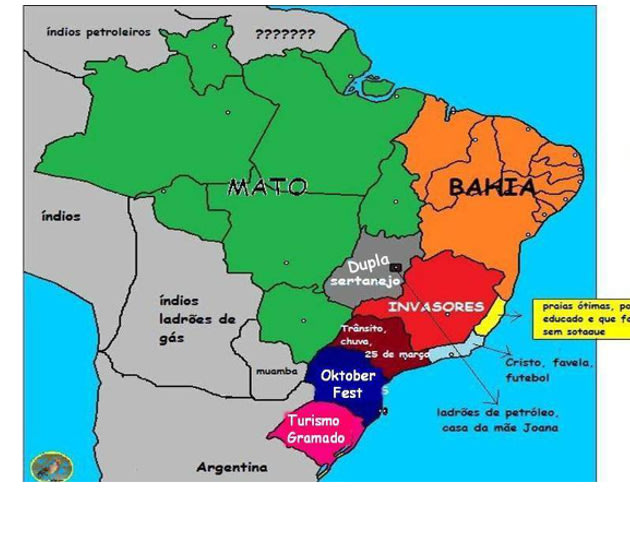
Um grupo de sulistas quer se separar do Brasil. Esse desejo embutido no coração de parte dos moradores da região nunca foi uma novidade. Mas, nos últimos anos, a mobilização pra viver livre do resto do país vem tomando corpo nas redes sociais.

O grupo "O Sul é o Meu País" reúne sulistas que desejam se separar do Brasil e viver sua vida em paz, sem a presença incômoda dos estados menos nobres da nação. Essa é a imagem de um país que dá certo:

Essa gente bonita faz questão de afirmar que faz um separatismo do bem, sem qualquer tipo de preconceito. Não tem nada contra o Brasil, nem com seu povo. Eles só querem viver em paz com seus bons modos forjados nos floridos campos europeus e se livrar "desse país atrasado", onde predomina o funk, o pagode, o axé e a pouca vergonha.

Veja como nossos "compatriotas" enxergam o país e o continente:

Assim como alguns paulistas chamam todos os nordestinos de "baiano", nossos separatistas do Sul chamam todo o nordeste de "Bahia", mostrando todo o seu respeito pela região. O norte e grande parte do centro-oeste são classificados como "Mato". No resto do continente, o único país que merece respeito é a Argentina, onde aparentemente as características europeias estão mais preservadas. Bolívia é tratada como "índios ladrões de gás", Paraguai é "muamba", Venezuela é "índios petroleiros" e o resto do continente é classificado genericamente como "índios".

Mas, claro, não se trata de preconceito com os povos não-brancos do continente. Nossos amigos apenas querem agregar valor ao seu bom gosto. Em enquete feita pra saber de quem será a torcida dos separatistas na Copa, uma massacrante maioria confessou estar torcendo contra o Brasil. A preferência dos membros do grupo varia entre Argentina, Uruguai, Holanda e Alemanha.

 Observação complementar:  O estado do Rio Grande do Sul faz parte intrínseca do território brasileiro desde o início.  Admiramos e respeitamos a tradição gaúcha, seu progresso, assim como admiramos e respeitamos as tradições culturais de outros estados como Minas Gerais, Bahia, Rio de Janeiro, e demais.  Mas eles tem que entender que não estamos mais na década de 30, onde São Paulo lutou práticamente sózinho. Hoje, somente a Grande São Paulo, capital, tem um PIB que é maior que dezenas de países, representa 70% do PIB da Argentina, é 4 vezes maior que o PIB da Coréia do Norte, é maior que o PIB de vários ESTADOS dos Estados Unidos, tomados isoladamente, representa 80% do PIB do seu estado (RS),  e por aí vai. (dados de 2011)  MAS NÃO NOS CONSIDERAMOS MAIS IMPORTANTES DO QUE OS OUTROS ESTADOS DA FEDERAÇÃO. QUALQUER UM DELES. 

Amigos gaúchos, gostamos muito de suas músicas, de suas danças, do seu sotaque, mas vocês são BRASILEIROS, e vão continuar sendo.  não se esqueçam disso. Se querem separar-se culturalmente, socialmente, e de outras formas, do restante do país, é um direito de vocês.  Mas não poderão separar-se políticamente, geográficamente. O “mato” a que vocês se referem na região Norte, é considerado o pulmão do mundo…..e dentro de algumas décadas será também economicamente muito importante, bem como a região Nordeste e Centro-Oeste.

Estão em 4º lugar em relação ao PIB dos estados brasileiros. Isso é muito importante, estão à frente de estados geográficamente bem maiores e políticamente importantes como Bahia, Goiás. Esqueçam esse patriotismo regional fora do contexto nacional, pátrio.

A História do Rio Grande do Sul é impressionante, mas estamos hoje em pleno século XXI e a realidade é bem outra.  Um abraço meus irmãos BRASILEIROS do Rio Grande do Sul.


As 100 melhores leis de Murphy

1.. Se alguma coisa pode dar errado, dará. E mais, dará errado da pior maneira, no pior momento e de modo que cause o maior dano possível.
2. Um atalho é sempre a distância mais longa entre dois pontos.
3. Nada é tão fácil quanto parece, nem tão difícil quanto a explicação do manual.
4. Tudo leva mais tempo do que todo o tempo que você tem disponível.
5. Se há possibilidade de várias coisas darem errado, todas darão - ou a que causar mais prejuízo.
6. Se você perceber que uma coisa pode dar errada de 4 maneiras e conseguir driblá-las, uma quinta surgirá do nada.
7. Seja qual for o resultado, haverá sempre alguém para:
a) interpretá-lo mal. b) falsificá-lo. c) dizer que já o tinha previsto em seu último relatório.
8. Quando um trabalho é mal feito, qualquer tentativa de melhorá-lo piora.
9. Acontecimentos infelizes sempre ocorrem em série.
10. Toda vez que se menciona alguma coisa: se é bom, acaba; se é ruim, acontece.
11. Em qualquer fórmula, as constantes (especialmente as registradas nos manuais de engenharia) deverão ser consideradas variáveis.
12. As peças que exigem maior manutenção ficarão no local mais inacessível do aparelho.
13. Se você tem alguma coisa há muito tempo, pode
jogar fora. Se você jogar fora alguma coisa que tem há muito tempo, vai precisar dela logo, logo.
14. Você sempre encontra aquilo que não está procurando.
15. Quando te ligam:
a) se você tem caneta, não tem papel.
b) se tem papel não tem caneta.
c) se tem ambos ninguém liga.
16. A Natureza está sempre à favor da falha.
17. Entre dois acontecimentos prováveis, sempre acontece um improvável.
18. Quase tudo é mais fácil de enfiar do que de tirar.
19. Mesmo o objeto mais inanimado tem movimento suficiente para ficar na sua frente e provocar uma canelada.
20. Qualquer esforço para se agarrar um objeto em queda provocará mais destruição do que se deixássemos o objeto cair naturalmente.
21. A única falta que o juiz de futebol apita com absoluta certeza é aquela em que ele está absolutamente errado.
22. Por mais bem feito que seja o seu trabalho, o patrão sempre achará onde criticá-lo.
23. Nenhum patrão mantém um
empregado que está certo o tempo todo.
24. Toda solução cria novos problemas.
25. Quando político fala em corrupção, os verbos são sempre usados no passado.
26. Você nunca vai pegar engarrafamento ou sinal fechado se saiu cedo demais para algum lugar.
27. Os assuntos mais simples são aqueles dos quais você não entende nada.
28. Dois monólogos não fazem um diálogo.
29. Se você é capaz de distinguir entre o bom e o mal conselho, então você não precisa de conselho.
30. Ninguém ficará batendo na sua porta, ou telefonando para você, se não houver trabalho algum a ser feito.
31. O trabalho mais chato é também o que menos paga.
32. Errar é humano. Perdoar não é a política da
empresa.
33. Toda a idéia revolucionária provoca três
estágios: 1º. é impossível - não perca meu tempo. 2º. é possível, mas não vale o esforço 3º. eu sempre disse que era uma boa idéia.
34. A informação que obriga a uma mudança radical no projeto sempre chega ao projetista depois do trabalho terminado, executado e funcionando maravilhosamente (também conhecida como síndrome do: "Porra! Mas só agora!!!").
35. Um homem com um relógio sabe a hora certa. Um homem com dois relógios sabe apenas a média.
36. Inteligência tem limite. Burrice não.
37. Seis fases de um projeto: Entusiasmo; Desilusão; Pânico; Busca dos culpados; Punição dos inocentes; Glória aos não participantes.
38. Conversas sérias, que são necessárias, só acontecem quando você está com pressa.
39. Não se dorme até que os filhos façam cinco anos.
40. Não se dorme depois que eles fazem quinze.
41. O orçamento
necessário é sempre o dobro do previsto. O tempo necessário é o triplo.
42. As variáveis variam menos que as constantes.
43. Pais que te amam não te deixam fazer nada. Pais liberais, não estão nem ai para você.
44. Entregas de caminhão que normalmente levam um dia levarão cinco quando você depender da entrega.
45. O único filho que ronca é o que quer dormir com você.
46. Assim que tiver esgotado todas as suas possibilidades e confessado seu fracasso, haverá uma solução simples e óbvia, claramente visível a qualquer outro idiota.
47. Qualquer programa quando começa a funcionar já está obsoleto.
48. Nenhuma bola vai parar em um vaso que você odeia.
49. Só quando um programa já está sendo usado há seis meses, é que se descobre um erro fundamental.
50. Crianças nunca ficam quietas para tirar fotos, e ficam absolutamente imóveis diante de uma câmera filmadora.
51. Nenhuma criança limpa quer colo.
52. A ferramenta quando cai no chão sempre rola para o canto mais inacessível do aposento. A caminho do canto, a ferramenta acerta primeiro o seu dedão.
53. Guia prático para a ciência moderna:
a) Se se mexe, pertence à biologia.
b) Se fede, pertence à química.
c) Se não funciona, pertence à física.
d) Se ninguém entende, é matemática.
e) Se não faz sentido, é psicologia.
54. O vírus que seu computador pegou, só ataca os arquivos que não tem cópia.
55. O número de exceções sempre ultrapassa o numero de regras. E há sempre exceções às exceções já estabelecidas.
56. Seja qual for o defeito do seu computador, ele vai desaparecer na frente de um técnico, retornando assim que ele se retirar.
57. Se ela está te dando mole, é feia. Se é bonita, está acompanhada. Se está sozinha, você está acompanhado.
58. Se o curso que você desejava fazer só tem n vagas, pode ter certeza de que você será o candidato n + 1 a tentar se matricular.
59. Oitenta por cento do exame final que você prestará, será baseado na única aula que você perdeu, baseada no único livro que você não leu.
60. Cada professor parte do pressuposto de que você não tem mais o que fazer, senão estudar a matéria dele.
61. A citação mais valiosa para a sua redação será aquela em que você não consegue lembrar o nome do autor.
62. Caras legais são feios. Caras bonitos não são legais. Caras bonitos e legais são gays.
63. A maioria dos trabalhos manuais exigem três mãos para serem executados.
64. As porcas que sobraram de um trabalho nunca se encaixam nos parafusos que também sobraram.
65. Quanto mais cuidadosamente você planejar um trabalho, maior será sua confusão mental quando algo der errado.
66. Tudo é possível. Apenas não muito provável.
67. Em qualquer circuito eletrônico, o componente de vida mais curta será instalado no lugar de mais difícil acesso.
68. Qualquer desenho de circuito eletrônico irá conter: uma peça obsoleta, duas impossíveis de encontrar, e três ainda sendo testadas.
69. O dia de hoje foi realmente necessário?
70. A luz no fim do túnel, é o trem vindo na sua direção.
71. A vida é uma droga. E você ainda reencarna.
72. Se está escrito "Tamanho Único", é porque não serve em ninguém.
73. Se o sapato serve, é feio!
74. Nunca há horas suficientes em um dia, mas sempre há muitos dias antes do sábado.
75. Todo corpo mergulhado numa banheira faz tocar o telefone.
76. A beleza está à flor da pele, mas a feiúra vai até o osso!
77. A informação mais necessária é sempre a menos disponível.
78. A probabilidade do pão cair com o lado da manteiga virado para baixo é proporcional ao valor do carpete.
79. Confiança é aquele sentimento que você tem antes de compreender a situação.
80. A fila do lado sempre anda mais rápido.
81. Nada é tão ruim que não possa piorar.
82. O material é danificado segundo a proporção direta do seu valor.
83. Se você está se sentindo bem, não se preocupe. Isso passa.
84. No ciclismo, não importa para onde você vai; é sempre morro acima e contra o vento.
85. Por mais tomadas que se tenham em casa, os móveis estão sempre na frente.
86. Existem dois tipos de esparadrapo: o que não gruda, e o que não sai.
87. Uma pessoa saudável é aquela que não foi suficientemente examinada.
88. Você sabe que é um dia ruim quando: O sol nasce no oeste; você pula da cama e erra o chão; o passarinho cantando lá fora é um urubu; seu bichinho de cerâmica te morde.
89. Por que será que números errados nunca estão ocupados?
90. Mas você nunca vai usar todo esse espaço de Winchester!
91. Se você não está confuso, não está prestando atenção.
92. Na guerra, o inimigo ataca em duas ocasiões: quando ele está preparado, e quando você não está.
93. Tudo que começa bem, termina mal. Tudo que começa mal, termina pior.
94. Amigos vêm e se vão, inimigos se acumulam.
95. "Pilhas não incluídas"
96. Você só precisará de um documento quando, espontaneamente, ele se mover do lugar que você o deixou para o lugar onde você não irá encontrá-lo.
97. As crianças são incríveis. Em geral, elas repetem palavra por palavra aquilo que você não deveria ter dito.
98. Uma maneira de se parar um cavalo de corrida é apostar nele.
99. Toda partícula que voa sempre encontra um olho.
100. Um morro nunca desce.

Ticiane


amar é admirar com  o coração

Ela é uma apresentadora (âncora) de um jornal de notícias da TV Bandeirantes.

Cada vez que ligo a TV e ela está apresentando as mais recentes notícias do Brasil e do mundo, eu não presto atenção às notícias.  Fico simplesmente vidrado nela, nas suas expressões, no seu maravilhoso sotaque nordestino, nos meneios de sua face, e principalmente na doçura de sua voz.

Ela é simplesmente maravilhosa. Não sei e nem quero saber como ela é em outras ocasiões, no seu lar, na sua vida cotidiana. Não deve ser muito diferente.  Se alguém me perguntasse qual seria meu ideal de uma figura feminina certamente Ticiane seria escolhida sem pestanejar.

Como eu gosto muito da música que transcrevo abaixo, dedico à Ticiane, com carinho.

SHE ( best performed by Engelbert Humperdinck)

She may be the face I can't forget
A trace of pleasure or regret
May be the treasure
Or the price I have to pay

She may be the song that summer sings
May be the chill that autumn brings
May be a hundred different things
Within the measure of a day

She may be the beauty or the beast
May be the famine or the feast
May turn each day into a heaven or a hell

She may be the mirror of my dreams
The smile reflected in the stream
She may not be what she may seem
Inside her shell

She who always seems so happy in a crowd,
Whose eyes can be so private and so proud
No ones allowed to see them when they cry

She may be the love that cannot hope to last
May come to me from shadows of the past
That I'd remember till the day I die

She may be the reason I survive
The why and wherefore I'm alive
The one I'll care for
Through the rough and ready years
Me, I'll take her laughter and her tears
And make them all my souvenirs
For where she goes I've got to be
The meaning of my life is She

She may be the love that cannot hope to last
May come to me from shadows of the past
That I'll remember till the day I die

She may be the reason I survive
The why and wherefore I'm alive
The one I'll care for
Through the rough and ready years
Me, I'll take her laughter and her tears
And make them all my souvenirs
For where she goes I've got to be
The meaning of my life is Ticiane…


                                                      Video >   https://www.youtube.com/watch?v=HeIs-yV5WNE

The social psychology of nerve cells


Cholinergic amacrine cells are distributed nonrandomly in the mouse retina.

The functional organization of the central nervous system depends upon a precise architecture and connectivity of distinct types of neurons. Multiple cell types are present within any brain structure, but the rules governing their positioning, and the molecular mechanisms mediating those rules, have been relatively unexplored.

A new study by UC Santa Barbara researchers demonstrates that a particular neuron, the cholinergic amacrine cell, creates a "personal space" in much the same way that people distance themselves from one another in an elevator. In addition, the study, published in the Proceedings of the National Academy of Sciences, shows that this feature is heritable and identifies a genetic contributor to it, pituitary tumor-transforming gene 1 (Pttg1).

Patrick Keeley, a postdoctoral scholar in Benjamin Reese's laboratory at UCSB's Neuroscience Research Institute, has been using the retina as a model system for exploring such principles of developmental neurobiology. The retina is ideal because this portion of the central nervous system lends itself to such spatial analysis.

"Populations of neurons in the retina are laid out in single strata within this layered structure, lending themselves to accurate quantitation and statistical analysis," explained Keeley. "Rather than being distributed as regular lattices of nerve cells, populations in the retina appear to abide by a simple rule, that of minimizing proximity to other cells of the same type. We would like to understand how such populations create and maintain such spacing behavior."

To address this, Keeley and colleagues quantified the regularity in the population of a particular type of amacrine cell in the mouse retina. They did so in 26 genetically distinct strains of mice and found that every strain exhibited this same self-spacing behavior but that some strains did so more efficiently than others. Amacrine cells are retinal interneurons that form connections between other neurons and regulate bipolar cell output.

"The regularity in the patterning of these amacrine cells showed little variation within each strain, while showing conspicuous variation between the strains, indicating a heritable component to this trait," said Keeley.

"This itself was something of a surprise, given that the patterning in such populations has an apparently stochastic quality to it," said Reese, a professor in the Department of Psychological and Brain Sciences. Stochastic systems are random and are analyzed, at least in part, using probability theory.

This strain variation in the regularity of this cellular patterning showed a significant linkage to a location in the genome on chromosome 11, where the researchers identified Pttg1, previously unknown to play any role in the retina.

Working in collaboration with colleagues at the University of Tennessee Health Science Center in Memphis, Keeley's team demonstrated that the expression of this gene varies across the 26 strains of mice and that there was a positive correlation between gene expression and regularity. They then identified a mutation in this gene that itself correlated with expression levels and with regularity. Working with colleagues at Cedars-Sinai Medical Center in Los Angeles, the team also demonstrated directly that this mutation controlled gene expression.

"Pttg1 has diverse functions, being an oncogene for pituitary tumors, and is known to have regulatory functions orchestrating gene expression elsewhere in the body," explained Keeley. "Within this class of retinal neurons, it should be regulating the way in which cells integrate signals from their immediate neighbors, translating that information to position the cell farthest from those neighbors." Future studies should decipher the genetic network controlled by Pttg1 that mediates such nerve-cell spacing.