Mostrando postagens com marcador Renewable energy. Mostrar todas as postagens

sexta-feira, 23 de outubro de 2015

Germany Could Be a Model for How We’ll Get Power in the Future


The European nation’s energy revolution has made it a leader in replacing nukes and fossil fuels with wind and solar technology.

By Robert Kunzig

Photographs by Luca Locatelli

Published October 15, 2015

Hamburg knew the bombs were coming, and so the prisoners of war and forced laborers had just half a year to build the giant flak bunker. By July 1943 it was finished. A windowless cube of reinforced concrete, with seven-foot-thick walls and an even thicker roof, it towered like a medieval castle above a park near the Elbe River. The guns protruding from its four turrets would sweep Allied bombers from the sky, the Nazis promised, while tens of thousands of citizens sheltered safely behind its impenetrable walls.

Coming in at night from the North Sea just weeks after the bunker was finished, British bombers steered for the spire of St. Nikolai in the center of the city. They dropped clouds of metallic foil strips to throw off German radar and flak gunners. Targeting crowded residential neighborhoods, the bombers ignited an unquenchable firestorm that destroyed half of Hamburg and killed more than 34,000 people. Towering walls of fire created winds so strong that people were blown into the flames. Church bells clanged furiously.

The spire of St. Nikolai, which somehow survived, stands today as a mahnmal—a memorial reminding Germany of the hell brought by the Nazis. The flak bunker is another mahnmal. But now it has a new meaning: An urban development agency (IBA Hamburg) and the municipal utility (Hamburg Energie) have transformed it from a powerful reminder of Germany’s shameful past into a hopeful vision for the future.

In the central space of the bunker, where people once cowered through the firestorm, a six-story, 528,000-gallon hot water tank delivers heat and hot water to some 800 homes in the neighborhood. The water is warmed by burning gas from sewage treatment, by waste heat from a nearby factory, and by solar panels that now cover the roof of the bunker, supported by struts angling from the old gun turrets. The bunker also converts sunlight into electricity; a scaffolding of photovoltaic (PV) panels on its south facade feeds enough juice into the grid to supply a thousand homes. On the north parapet, from which the flak gunners once watched flames rising from the city center, an outdoor café offers a view of the changed skyline. It’s dotted with 17 wind turbines now.

Picture of the windmills in Germany

Wind turbines surround a coal-fired power plant near Garzweiler in western Germany. Renewables now generate 27 percent of the country’s electricity, up from 9 percent a decade ago. Eventually they’ll crowd out coal—although Germany is switching off its nuclear plants first.

Germany is pioneering an epochal transformation it calls the energiewende—an energy revolution that scientists say all nations must one day complete if a climate disaster is to be averted. Among large industrial nations, Germany is a leader. Last year about 27 percent of its electricity came from renewable sources such as wind and solar power, three times what it got a decade ago and more than twice what the United States gets today. The change accelerated after the 2011 meltdown at Japan’s Fukushima nuclear power plant, which led Chancellor Angela Merkel to declare that Germany would shut all 17 of its own reactors by 2022. Nine have been switched off so far, and renewables have more than picked up the slack.

What makes Germany so important to the world, however, is the question of whether it can lead the retreat from fossil fuels. By later this century, scientists say, planet-warming carbon emissions must fall to virtually zero. Germany, the world’s fourth largest economy, has promised some of the most aggressive emission cuts—by 2020, a 40 percent cut from 1990 levels, and by 2050, at least 80 percent.

What makes Germany so important, however, is the question of whether it can lead the retreat from fossil fuels.

The fate of those promises hangs in the balance right now. The German revolution has come from the grass roots: Individual citizens and energygenossenschaften—local citizens associations—have made half the investment in renewables. But conventional utilities, which didn’t see the revolution coming, are pressuring Merkel’s government to slow things down. The country still gets far more electricity from coal than from renewables. And the energiewende has an even longer way to go in the transportation and heating sectors, which together emit more carbon dioxide (CO₂) than power plants.

German politicians sometimes compare the energiewende to the Apollo moon landing. But that feat took less than a decade, and most Americans just watched it on TV. The energiewende will take much longer and will involve every single German—more than 1.5 million of them, nearly 2 percent of the population, are selling electricity to the grid right now. “It’s a project for a generation; it’s going to take till 2040 or 2050, and it’s hard,” said Gerd Rosenkranz, a former journalist at Der Spiegel who’s now an analyst at Agora Energiewende, a Berlin think tank. “It’s making electricity more expensive for individual consumers. And still, if you ask people in a poll, Do you want the energiewende? then 90 percent say yes.”

Why? I wondered as I traveled in Germany last spring. Why is the energy future happening here, in a country that was a bombed-out wasteland 70 years ago? And could it happen everywhere?

The Germans have an origin myth: It says they came from the dark and impenetrable heart of the forest. It dates back to the Roman historian Tacitus, who wrote about the Teutonic hordes who massacred Roman legions, and it was embellished by German Romantics in the 19th century. Through the upheavals of the 20th century, according to ethnographer Albrecht Lehmann, the myth remained a stable source of German identity. The forest became the place where Germans go to restore their souls—a habit that predisposed them to care about the environment.

So in the late 1970s, when fossil fuel emissions were blamed for killing German forests with acid rain, the outrage was nationwide. The oil embargo of 1973 had already made Germans, who have very little oil and gas of their own, think about energy. The threat of waldsterben, or forest death, made them think harder.

Picture of an abandoned nuclear facility in Germany

Picture of a man dismantling a nuclear facility in Germany

Workers have been taking apart this Soviet-era nuclear power plant, near Greifswald in eastern Germany, since 1995, cleaning radioactive surfaces with steel grit so the metal can be recycled. Germany plans to shut all its reactors by 2022.

Government and utilities were pushing nuclear power—but many Germans were pushing back. This was new for them. In the decades after World War II, with a ruined country to rebuild, there had been little appetite for questioning authority or the past. But by the 1970s, the rebuilding was complete, and a new generation was beginning to question the one that had started and lost the war. “There’s a certain rebelliousness that’s a result of the Second World War,” a 50-something man named Josef Pesch told me. “You don’t blindly accept authority.”

Pesch was sitting in a mountaintop restaurant in the Black Forest outside Freiburg. In a snowy clearing just uphill stood two 320-foot-tall wind turbines funded by 521 citizen investors recruited by Pesch—but we weren’t talking about the turbines yet. With an engineer named Dieter Seifried, we were talking about the nuclear reactor that never got built, near the village of Wyhl, 20 miles away on the Rhine River.

The state government had insisted that the reactor had to be built or the lights would go out in Freiburg. But beginning in 1975, local farmers and students occupied the site. In protests that lasted nearly a decade, they forced the government to abandon its plans. It was the first time a nuclear reactor had been stopped in Germany.

The lights didn’t go out, and Freiburg became a solar city. Its branch of the Fraunhofer Institute is a world leader in solar research. Its Solar Settlement, designed by local architect Rolf Disch, who’d been active in the Wyhl protests, includes 50 houses that all produce more energy than they consume. “Wyhl was the starting point,” Seifried said. In 1980 an institute that Seifried co-founded published a study called Energiewende—giving a name to a movement that hadn’t even been born yet.

Picture of a dismantled nuclear facility turned into a theme park in Germany

A nuclear reactor at Kalkar was finished just before the 1986 explosion at Chernobyl, Ukraine—and never used. It’s now an amusement park with a ride in what would have been the cooling tower. Fear of nuclear power spurred Germany’s transition.

It wasn’t born of a single fight. But opposition to nuclear power, at a time when few people were talking about climate change, was clearly a decisive factor. I had come to Germany thinking the Germans were foolish to abandon a carbon-free energy source that, until Fukushima, produced a quarter of their electricity. I came away thinking there would have been no energiewende at all without antinuclear sentiment—the fear of meltdown is a much more powerful and immediate motive than the fear of slowly rising temperatures and seas.

All over Germany I heard the same story. From Disch, sitting in his own cylindrical house, which rotates to follow the sun like a sunflower. From Rosenkranz in Berlin, who back in 1980 left physics graduate school for months to occupy the site of a proposed nuclear waste repository. From Luise Neumann-Cosel, who occupied the same site two decades later—and who is now leading a citizens’ initiative to buy the Berlin electric grid. And from Wendelin Einsiedler, a Bavarian dairy farmer who has helped transform his village into a green dynamo.

All of them said Germany had to get off nuclear power and fossil fuels at the same time. “You can’t drive out the devil with Beelzebub,” explained Hans-Josef Fell, a prominent Green Party politician. “Both have to go.” At the University of Applied Sciences in Berlin, energy researcher Volker Quaschning put it this way: “Nuclear power affects me personally. Climate change affects my kids. That’s the difference.”

Germany has Europe’s second highest consumer electricity prices, yet public support for its energiewende—an aggressive transition to renewable energy—is at an impressive 92 percent. The support is rooted in an eco-friendly culture, a collective desire to abandon nuclear energy, and laws that allow citizens to profit from selling their energy to the grid. Roughly 27 percent of Germany’s electricity is from renewables; the goal is at least 80 percent by 2050.

Map of Power Generation in Germany, 2014

**Reactor closed prior to 2011

Map of Power Generation in Germany, 2050

Renewables as share of electricty generation

Total emissions (CO2 equivalent), 1990-2012

*Latest available data

If you ask why antinuclear sentiment has been so much more consequential in Germany than, say, across the Rhine in France, which still gets 75 percent of its electricity from nukes, you end up back at the war. It left Germany a divided country, the front along which two nuclear superpowers faced off. Demonstrators in the 1970s and ’80s were protesting not just nuclear reactors but plans to deploy American nuclear missiles in West Germany. The two didn’t seem separable. When the German Green Party was founded in 1980, pacifism and opposition to nuclear power were both central tenets.

In 1983 the first Green representatives made it into the Bundestag, the national parliament, and started injecting green ideas into the political mainstream. When the Soviet reactor at Chernobyl exploded in 1986, the left-leaning Social Democrats (SPD), one of Germany’s two major parties, was converted to the antinuclear cause. Even though Chernobyl was hundreds of miles away, its radioactive cloud passed over Germany, and parents were urged to keep their children inside. It’s still not always safe to eat mushrooms or wild boar from the Black Forest, Pesch said. Chernobyl was a watershed.

But it took Fukushima, 25 years later, to convince Merkel and her Christian Democratic Union (CDU) that all nuclear reactors should be switched off by 2022. By then the boom of renewable energy was in full swing. And a law that Hans-Josef Fell had helped create back in 2000 was the main reason.

Fell’s house in Hammelburg, the town in northern Bavaria where he was born and raised, is easy to spot among all the pale postwar stucco: It’s the one built of dark larch wood, with a grass roof. On the south side, facing the backyard, the grass is partially covered by photovoltaic and solar hot water panels. When there’s not enough sun to produce electricity or heat, a cogenerator in the basement burns sunflower or rapeseed oil to produce both. On the March morning when I visited, the wood interior of the house was bathed in sunlight and warmth from the conservatory. In a few weeks, Fell said, wildflowers would be blooming on the roof.

A tall man in jeans and Birkenstocks, with a bald, egg-shaped head and a fringe of gray beard, Fell has moments of sounding like a preacher—but he’s no green ascetic. A shed in his backyard, next to the swimming pond, houses a sauna, powered by the same green electricity that powers his house and his car. “The environmental movement’s biggest mistake has been to say, ‘Do less. Tighten your belts. Consume less,’ ” Fell said. “People associate that with a lower quality of life. ‘Do things differently, with cheap, renewable electricity’—that’s the message.”

See how German citizens are preparing for more renewable energy industries.

From Fell’s garden, on a clear day, you used to be able to see the white steam plumes of the nuclear reactor at Grafenrheinfeld. His father, the conservative mayor of Hammelburg, supported nuclear power and the local military base. Young Fell demonstrated at Grafenrheinfeld and went to court to refuse military service. Years later, after his father had retired, Fell was elected to the Hammelburg city council.

It was 1990, the year Germany was officially reunified—and while the country was preoccupied with that monumental task, a bill boosting the energiewende made its way through the Bundestag without much public notice. Just two pages long, it enshrined a crucial principle: Producers of renewable electricity had the right to feed into the grid, and utilities had to pay them a “feed-in tariff.” Wind turbines began to sprout in the windy north.

But Fell, who was installing PV panels on his roof in Hammelburg, realized that the new law would never lead to a countrywide boom: It paid people to produce energy, but not enough. In 1993 he got the city council to pass an ordinance obliging the municipal utility to guarantee any renewable energy producer a price that more than covered costs. Fell promptly organized an association of local investors to build a 15-kilowatt solar power plant—tiny by today’s standards, but the association was one of the first of its kind. Now there are hundreds in Germany.

In 1998 Fell rode a Green wave and his success in Hammelburg into the Bundestag. The Greens formed a governing coalition with the SPD. Fell teamed up with Hermann Scheer, a prominent SPD advocate of solar energy, to craft a law that in 2000 took the Hammelburg experiment nationwide and has since been imitated around the world. Its feed-in tariffs were guaranteed for 20 years, and they paid well.

“My basic principle,” Fell said, “was the payment had to be so high that investors could make a profit. We live in a market economy, after all. It’s logical.”

Picture of a coal field in Germany

Renewables are booming, but Germany’s use of lignite, the dirtiest coal, hasn’t declined. At Vattenfall’s Welzow-Süd mine, some of the world’s largest machines claw 22 million tons a year from a 45-foot-thick seam. How long will that go on? “Very long, I hope,” said Jan Domann, a young engineer. “We have enough lignite.”

Fell was about the only German I met who claimed not to have been surprised at the boom his logic unleashed. “That it would be possible to this extent—I didn’t believe that then,” said dairy farmer Wendelin Einsiedler. Outside his sunroom, which overlooks the Alps, nine wind turbines turned lazily on the ridge behind the cow pen. The smell of manure drifted in. Einsiedler had started his personal energiewende in the 1990s with a single turbine and a methane-producing manure fermenter. He and his brother Ignaz, also a dairy farmer, burned the methane in a 28-kilowatt cogenerator, generating heat and electricity for their farms. “There was no question of making money,” Einsiedler said. “It was idealism.”

But after the renewable energy law took effect in 2000, the Einsiedlers expanded. Today they have five fermenters, which process corn silage as well as manure from eight dairy farms, and they pipe the resulting biogas three miles to the village of Wildpoldsried. There it’s burned in cogenerators to heat all the public buildings, an industrial park, and 130 homes. “It’s a wonderful principle, and it saves an unbelievable amount of CO₂,” said Mayor Arno Zengerle.

The biogas, the solar panels that cover many roofs, and especially the wind turbines allow Wildpoldsried to produce nearly five times as much electricity as it consumes. Einsiedler manages the turbines, and he’s had little trouble recruiting investors. Thirty people invested in the first one; 94 jumped on the next. “These are their wind turbines,” Einsiedler said. Wind turbines are a dramatic and sometimes controversial addition to the German landscape—“asparagification,” opponents call it—but when people have a financial stake in the asparagus, Einsiedler said, their attitude changes.

Picture of Bill Nye standing in front of smoke stacks

Bill Nye’s Global Meltdown

Watch the National Geographic Channel on Sunday, November 1, at 8/7c as Bill Nye explores the five stages of climate change grief—from denial to acceptance.

It wasn’t hard to persuade farmers and homeowners to put solar panels on their roofs; the feed-in tariff, which paid them 50 cents a kilowatt-hour when it started in 2000, was a good deal. At the peak of the boom, in 2012, 7.6 gigawatts of PV panels were installed in Germany in a single year—the equivalent, when the sun is shining, of seven nuclear plants. A German solar-panel industry blossomed, until it was undercut by lower-cost manufacturers in China—which took the boom worldwide.

Fell’s law, then, helped drive down the cost of solar and wind, making them competitive in many regions with fossil fuels. One sign of that: Germany’s tariff for large new solar facilities has fallen from 50 euro cents a kilowatt-hour to less than 10. “We’ve created a completely new situation in 15 years—that’s the huge success of the renewable energy law,” Fell said.

Germans paid for this success not through taxes but through a renewable-energy surcharge on their electricity bills. This year the surcharge is 6.17 euro cents per kilowatt-hour, which for the average customer amounts to about 18 euros a month—a hardship for some, Rosenkranz told me, but not for the average German worker. The German economy as a whole devotes about as much of its gross national product to electricity as it did in 1991.

In the 2013 elections Fell lost his seat in the Bundestag, a victim of internal Green Party politics. He’s back in Hammelburg now, but he doesn’t have to look at the steam plumes from Grafenrheinfeld: Last June the reactor became the latest to be switched off. No one, not even the industry, thinks nuclear is coming back in Germany. Coal is another story.

Picture of a plane over solar panels

Picture of workers at the Leipzig factory building i8 and i3 cars

Picture of a man preparing a wind turbine blade at the Siemens factory in Denmark

Picture of wind turbine being repaired in the North Sea

Picture of German offshore wind turbines


A sea of photovoltaic panels surrounds the runway at the Eberswalde-Finow Airport, 30 miles north of Berlin. Germany is at the same latitude as Labrador, Canada, but has installed more solar capacity than any other country. Most panels are on rooftops.

Germany got 44 percent of its electricity from coal last year—18 percent from hard coal, which is mostly imported, and about 26 percent from lignite, or brown coal. The use of hard coal has declined substantially over the past two decades, but not the use of lignite. That’s a major reason Germany isn’t on track to meet its own greenhouse gas emissions target for 2020.

Germany is the world’s leading producer of lignite. It emits even more CO₂ than hard coal, but it’s the cheapest fossil fuel—cheaper than hard coal, which is cheaper than natural gas. Ideally, to reduce emissions, Germany should replace lignite with gas. But as renewables have flooded the grid, something else has happened: On the wholesale market where contracts to deliver electricity are bought and sold, the price of electricity has plummeted, such that gas-fired power plants and sometimes even plants burning hard coal are priced out of the market. Old lignite-fired power plants are rattling along at full steam, 24/7, while modern gas-fired plants with half the emissions are standing idle.

“Of course we have to find a track to get rid of our coal—it’s very obvious,” said Jochen Flasbarth, state secretary in the environment ministry. “But it’s quite difficult. We are not a very resource-rich country, and the one resource we have is lignite.”

Picture of the cliffside in Germany

The chalk cliffs at Jasmund National Park on the Baltic have drawn tourists for centuries. The beech woods there are a remnant of the forest that once covered Germany. According to Romantic lore, the forest forged the German identity as a nature-loving people—a key inspiration for the clean-energy movement. When a quarry threatened this site in the 1920s, ranger Rico Markmann explains, “the populace didn’t stand for it.”

Curtailing its use is made harder by the fact that Germany’s big utilities have been losing money lately—because of the energiewende, they say; because of their failure to adapt to the energiewende, say their critics. E.ON, the largest utility, which owns Grafenrheinfeld and many other plants, declared a loss of more than three billion euros last year.

“The utilities in Germany had one strategy,” Flasbarth said, “and that was to defend their track—nuclear plus fossil. They didn’t have a strategy B.” Having missed the energiewende train as it left the station, they’re now chasing it. E.ON is splitting into two companies, one devoted to coal, gas, and nuclear, the other to renewables. The CEO, once a critic of the energiewende, is going with the renewables.

Vattenfall, a Swedish state-owned company that’s another one of Germany’s four big utilities, is attempting a similar evolution. “We’re a role model for the energiewende,” spokesperson Lutz Wiese said cheerfully as he greeted me at Welzow-Süd—an open-pit mine on the Polish border that produces 22 million tons of lignite a year. In a trench that covers 11 square miles and is more than 300 feet deep, 13 gargantuan digging machines work in synchrony—moving the trench through the landscape, exposing and removing the lignite seam, and dumping the overburden behind them so the land can be replanted. In one recultivated area there’s a small experimental vineyard. On the same rebuilt hill stands a memorial to Wolkenberg, a village consumed by the mine in the 1990s. Boulders mark the spots where the church and other buildings once stood.

It was a gorgeous spring day; from Wolkenberg, the only cloud we could see was the lazily billowing steam plume from the 1.6-gigawatt power plant at Schwarze Pumpe, which burns most of the lignite mined at Welzow-Süd. In a conference room, Olaf Adermann, asset manager for Vattenfall’s lignite operations, explained that Vattenfall and other utilities had never expected renewables to take off so fast. Even with the looming shutdown of more nuclear reactors, Germany has too much generating capacity.

Picture of a people riding segways in Germany

Citizens have funded half of Germany’s investment in renewable energy after a law made it profitable. Outside the village of Feldheim, visitors tour the wind park. It sells electricity to the national grid—but also supplies a local grid that makes Feldheim self-sufficient.

“We have to face some kind of a market cleaning,” Adermann said. But lignite shouldn’t be the one to go, he insisted: It’s the “reliable and flexible partner” when the sun isn’t shining or the wind isn’t blowing. Adermann, who’s from the region and worked for its lignite mines before they belonged to Vattenfall, sees them continuing to 2050—and maybe beyond.

Vattenfall, however, plans to sell its lignite business, if it can find a buyer, so it can focus on renewables. It’s investing billions of euros in two new offshore wind parks in the North Sea—because there’s more wind offshore than on and because a large corporation needs a large project to pay its overhead. “We can’t do onshore in Germany,” Wiese said. “It’s too small.”

Vattenfall isn’t alone: The renewables boom has moved into the North and Baltic Seas and, increasingly, into the hands of the utilities. Merkel’s government has encouraged the shift, capping construction of solar and onshore wind and changing the rules in ways that shut out citizens associations. Last year the amount of new solar fell to around 1.9 gigawatts, a quarter of the 2012 peak. Critics say the government is helping big utilities at the expense of the citizens’ movement that launched the energiewende.

At the end of April, Vattenfall formally inaugurated its first German North Sea wind park, an 80-turbine project called DanTysk that lies some 50 miles offshore. The ceremony in a Hamburg ballroom was a happy occasion for the city of Munich too. Its municipal utility, Stadtwerke München, owns 49 percent of the project. As a result Munich now produces enough renewable electricity to supply its households, subway, and tram lines. By 2025 it plans to meet all of its demand with renewables.

In part because it has retained a lot of heavy industry, Germany has some of the highest per capita carbon emissions in western Europe. (They’re a bit more than half of U.S. emissions.) Its goal for 2020 is to cut them by 40 percent from 1990 levels. As of last year, it had achieved 27 percent. The European carbon-trading system, in which governments issue tradable emissions permits to polluters, hasn’t been much help so far. There are too many permits in circulation, and they’re so cheap that industry has little incentive to cut emissions.

Though Germany isn’t on track to meet its own goal for 2020, it’s ahead of the European Union’s schedule. It could have left things there—and many in Merkel’s CDU wanted her to do just that. Instead, she and Economics Minister Sigmar Gabriel, head of the SPD, reaffirmed their 40 percent commitment last fall.

They haven’t proved they can meet it, however. Last spring Gabriel proposed a special emissions levy on old, inefficient coal plants; he soon had 15,000 miners and power plant workers, encouraged by their employers, demonstrating outside his ministry. In July the government backed down. Instead of taxing the utilities, it said it would pay them to shut down a few coal plants—achieving only half the planned emissions savings. For the energiewende to succeed, Germany will have to do much more.

Picture of a dismantled nuclear facility turned theme park

In 1996 the Kalkar nuclear reactor site, on the Rhine near Holland, opened as an amusement park: Wunderland Kalkar. By 2050 Germany aims to be a new kind of wonderland—an industrial country that uses half as much energy as before and gets at least 80 percent from renewables.

It will have to get off gasoline and diesel too. The transportation sector produces about 17 percent of Germany’s emissions. Like the utilities, its famous carmakers—Mercedes-Benz, BMW, Volkswagen, and Audi—were late to the energiewende. But today they’re offering more than two dozen models of electric cars. The government’s goal is to have a million electric cars on the road by 2020; so far there are about 40,000. The basic problem is that the cars are still too expensive for most Germans, and the government hasn’t offered serious incentives to buy them—it hasn’t done for transportation what Fell’s law did for electricity.

Much the same is true of buildings, whose heating systems emit 30 percent of Germany’s greenhouse gases. Rolf Disch in Freiburg is one of many architects who have built houses and buildings that consume almost no net energy or produce a surplus. But Germany is not putting up many new buildings. “The strategy has always been to modernize old buildings in such a way that they use almost no energy and cover what they do use with renewables,” said Matthias Sandrock, a researcher at the Hamburg Institute. “That’s the strategy, but it’s not working. A lot is being done, but not enough.”

All over Germany, old buildings are being wrapped in six inches of foam insulation and refitted with modern windows. Low-interest loans from the bank that helped rebuild the war-torn west with Marshall Plan funds pay for many projects. Just one percent of the stock is being renovated every year, though. For all buildings to be nearly climate neutral by 2050—the official goal—the rate would need to double at least. Once, Sandrock said, the government floated the idea of requiring homeowners to renovate. The public outcry shot that trial balloon down.

“After Fukushima, for a short time there was aufbruchstimmung—for about half a year there was a real euphoria,” said Gerd Rosenkranz. Aufbruchstimmung means something like “the joy of departure”; it’s what a German feels when he’s setting out on a long hike, say, in the company of friends. With all the parties in Germany in agreement, Rosenkranz said, the energiewende felt like that. But the feeling hasn’t lasted. Economic interests are clashing now. Some Germans say it might take another catastrophe like Fukushima to catalyze a fresh burst of progress. “The mood is bad,” Rosenkranz said.

They knew the energiewende was never going to be a walk in the forest, and yet they set out on it. What can we learn from them?

But here’s the thing about the Germans: They knew the energiewende was never going to be a walk in the forest, and yet they set out on it. What can we learn from them? We can’t transplant their desire to reject nuclear power. We can’t appropriate their experience of two great nation-changing projects—rebuilding their country when it seemed impossible, 70 years ago, and reunifying their country when it seemed forever divided, 25 years ago. But we can be inspired to think that the energiewende might be possible for other countries too.

In a recent essay William Nordhaus, a Yale economist who has spent decades studying the problem of addressing climate change, identified what he considers its essence: free riders. Because it’s a global problem, and doing something is costly, every country has an incentive to do nothing and hope that others will act. While most countries have been free riders, Germany has behaved differently: It has ridden out ahead. And in so doing, it has made the journey easier for the rest of us.


http://ngm.nationalgeographic.com/2015/11/climate-change/germany-renewable-energy-revolution-text

quinta-feira, 1 de outubro de 2015

Renewables overtake coal in the UK energy mix for the first time


Renewable energy sources (combined solar, wind and biofuel) have overtaken coal, the most polluting energy source, ...

Renewable energy sources (combined solar, wind and biofuel) have overtaken coal, the most polluting energy source, in the UK for the first time (Credit:Shutterstock)

Thanks to an increase in solar panels and wind turbines, as well as a particularly sunny and windy quarter, renewable energy has supplied a record 25 percent of the UK’s energy mix in Q2 2015, leapfrogging coal for the first time to come into second place behind gas fired electricity. It’s nearly a 10 percent increase on the same period last year.

Total renewable energy generation rose by 51.4 percent compared to Q2 2014, with solar jumping by 115 percent, wind rising 65.2 percent thanks to expanded offshore installations, and bioenergy improving by 26.2 percent, largely due to one unit at Drax power station switching from coal to woodchip burning. Since 2012, the share of renewable energy has been rising fairly consistently.

This strong result comes in the middle of a difficult year for renewables, with David Cameron’s conservative government totally ending subsidies for new on-shore wind farms, and slashing solar power support as well.

Still, the situation is not looking strong for coal producers, with Goldman Sachs releasing a research paper suggesting we may already have passed "peak coal."According to the paper, Goldman believes demand for coal peaked in 2013 and will only decline in the coming years. Its projected long-term price for coal is now US$50 per tonne, down from US$65 per tonne in previous projections.

Source: UK Energy Statistics, Q2 2015


http://www.gizmag.com/renewables-overtake-coal-uk-energy-mix/39602

domingo, 13 de setembro de 2015

Aspen, Colorado becomes third U.S. city powered totally by renewable energy


by Colin Payne, 09/07/15

aspen powered by renewable energy, city powered by 100 percent renewable energy, aspen 100 percent renewable, renewable energy, green power, energy, electricity, geothermal

Three is a magic number, and Aspen, Colorado has hit that enchanted numeral by becoming the third city in the U.S. to power itself with 100 percent renewable energy. Aspen Times reports that the city has reached the milestone after more than a decade of work, by employing wind, solar and geothermal energy. Its efforts put the Rocky Mountain hub in a very exclusive renewable energy club, along with Burlington, Vermont and Greensburg, Kansas.

aspen powered by renewable energy, city powered by 100 percent renewable energy, aspen 100 percent renewable, renewable energy, green power, energy, electricity, geothermal

It was a very forward-thinking goal and a truly remarkable achievement,” says Aspen’s Director of Utilities and Environmental Initiatives, David Hornbacher. “This means we are powered by the forces of nature, predominantly water and wind with a touch of solar and landfill gas.”

Related: New artificial leaf technology could revolutionize renewable energy production

The city’s clean energy transition became official on Thursday last week when the city signed an agreement with Municipal Energy Agency of Nebraska – which replaced the remaining 20 to 25 percent of its energy needs it was previously getting from coal.

“We’ve demonstrated that it’s possible,” and that a small, progressive community can work together to be a pathway for others, Hornbacher told the Aspen Times. “Realistically, we hope we can inspire others to achieve these higher goals.”

Georgetown, Texas is expected to be fully powered by renewable energy as of 2017, and according to the Environmental and Energy Study Institute, others have committed, including: San Diego and San Jose, California.

Via Aspen Times

Images via Shutterstock (1, 2)


http://inhabitat.com/aspen-co-becomes-third-u-s-city-powered-totally-by-renewable-energy/

sexta-feira, 4 de setembro de 2015

Process uses light-harvesting nanoparticles, captures energy from 'hot electrons'


Rice University researchers have demonstrated an efficient new way to capture the energy from sunlight and convert it into clean, renewable energy by splitting water molecules.

Credit: I. Thomann/Rice University

Rice University researchers have demonstrated an efficient new way to capture the energy from sunlight and convert it into clean, renewable energy by splitting water molecules.

The technology, which is described online in the American Chemical Society journal Nano Letters, relies on a configuration of light-activated gold nanoparticles that harvest sunlight and transfer solar energy to highly excited electrons, which scientists sometimes refer to as "hot electrons."

"Hot electrons have the potential to drive very useful chemical reactions, but they decay very rapidly, and people have struggled to harness their energy," said lead researcher Isabell Thomann, assistant professor of electrical and computer engineering and of chemistry and materials science and nanoengineering at Rice. "For example, most of the energy losses in today's best photovoltaic solar panels are the result of hot electrons that cool within a few trillionths of a second and release their energy as wasted heat."

Capturing these high-energy electrons before they cool could allow solar-energy providers to significantly increase their solar-to-electric power-conversion efficiencies and meet a national goal of reducing the cost of solar electricity.

In the light-activated nanoparticles studied by Thomann and colleagues at Rice's Laboratory for Nanophotonics (LANP), light is captured and converted into plasmons, waves of electrons that flow like a fluid across the metal surface of the nanoparticles. Plasmons are high-energy states that are short-lived, but researchers at Rice and elsewhere have found ways to capture plasmonic energy and convert it into useful heat or light. Plasmonic nanoparticles also offer one of the most promising means of harnessing the power of hot electrons, and LANP researchers have made progress toward that goal in several recent studies.

Thomann and her team, graduate students Hossein Robatjazi, Shah Mohammad Bahauddin and Chloe Doiron, created a system that uses the energy from hot electrons to split molecules of water into oxygen and hydrogen. That's important because oxygen and hydrogen are the feedstocks for fuel cells, electrochemical devices that produce electricity cleanly and efficiently.

To use the hot electrons, Thomann's team first had to find a way to separate them from their corresponding "electron holes," the low-energy states that the hot electrons vacated when they received their plasmonic jolt of energy. One reason hot electrons are so short-lived is that they have a strong tendency to release their newfound energy and revert to their low-energy state. The only way to avoid this is to engineer a system where the hot electrons and electron holes are rapidly separated from one another. The standard way for electrical engineers to do this is to drive the hot electrons over an energy barrier that acts like a one-way valve. Thomann said this approach has inherent inefficiencies, but it is attractive to engineers because it uses well-understood technology called Schottky barriers, a tried-and-true component of electrical engineering.

"Because of the inherent inefficiencies, we wanted to find a new approach to the problem," Thomann said. "We took an unconventional approach: Rather than driving off the hot electrons, we designed a system to carry away the electron holes. In effect, our setup acts like a sieve or a membrane. The holes can pass through, but the hot electrons cannot, so they are left available on the surface of the plasmonic nanoparticles."

The setup features three layers of materials. The bottom layer is a thin sheet of shiny aluminum. This layer is covered with a thin coating of transparent nickel-oxide, and scattered atop this is a collection of plasmonic gold nanoparticles -- puck-shaped disks about 10 to 30 nanometers in diameter.

When sunlight hits the discs, either directly or as a reflection from the aluminum, the discs convert the light energy into hot electrons. The aluminum attracts the resulting electron holes and the nickel oxide allows these to pass while also acting as an impervious barrier to the hot electrons, which stay on gold. By laying the sheet of material flat and covering it with water, the researchers allowed the gold nanoparticles to act as catalysts for water splitting. In the current round of experiments, the researchers measured the photocurrent available for water splitting rather than directly measuring the evolved hydrogen and oxygen gases produced by splitting, but Thomann said the results warrant further study.

"Utilizing hot electron solar water-splitting technologies we measured photocurrent efficiencies that were on par with considerably more complicated structures that also use more expensive components," Thomann said. "We are confident that we can optimize our system to significantly improve upon the results we have already seen."


Story Source:

The above post is reprinted from materials provided by Rice University. Note: Materials may be edited for content and length.


Journal Reference:

  1. Hossein Robatjazi, Shah Mohammad Bahauddin, Chloe Doiron, Isabell Thomann. Direct Plasmon-Driven Photoelectrocatalysis. Nano Letters, 2015; 150806081425003 DOI: 10.1021/acs.nanolett.5b02453


domingo, 30 de agosto de 2015

Artificial leaf harnesses sunlight for efficient fuel production


A highly efficient photoelectrochemical (PEC) device uses the power of the sun to split water into hydrogen and oxygen. The stand-alone prototype includes two chambers separated by a semi-permeable membrane that allows collection of both gas products.

Credit: Lance Hayashida/Caltech

Generating and storing renewable energy, such as solar or wind power, is a key barrier to a clean-energy economy. When the Joint Center for Artificial Photosynthesis (JCAP) was established at Caltech and its partnering institutions in 2010, the U.S. Department of Energy (DOE) Energy Innovation Hub had one main goal: a cost-effective method of producing fuels using only sunlight, water, and carbon dioxide, mimicking the natural process of photosynthesis in plants and storing energy in the form of chemical fuels for use on demand. Over the past five years, researchers at JCAP have made major advances toward this goal, and they now report the development of the first complete, efficient, safe, integrated solar-driven system for splitting water to create hydrogen fuels.

"This result was a stretch project milestone for the entire five years of JCAP as a whole, and not only have we achieved this goal, we also achieved it on time and on budget," says Caltech's Nate Lewis, George L. Argyros Professor and professor of chemistry, and the JCAP scientific director.

The new solar fuel generation system, or artificial leaf, is described in the August 24 online issue of the journal Energy and Environmental Science. The work was done by researchers in the laboratories of Lewis and Harry Atwater, director of JCAP and Howard Hughes Professor of Applied Physics and Materials Science.

"This accomplishment drew on the knowledge, insights and capabilities of JCAP, which illustrates what can be achieved in a Hub-scale effort by an integrated team," Atwater says. "The device reported here grew out of a multi-year, large-scale effort to define the design and materials components needed for an integrated solar fuels generator."

The new system consists of three main components: two electrodes--one photoanode and one photocathode--and a membrane. The photoanode uses sunlight to oxidize water molecules, generating protons and electrons as well as oxygen gas. The photocathode recombines the protons and electrons to form hydrogen gas. A key part of the JCAP design is the plastic membrane, which keeps the oxygen and hydrogen gases separate. If the two gases are allowed to mix and are accidentally ignited, an explosion can occur; the membrane lets the hydrogen fuel be separately collected under pressure and safely pushed into a pipeline.

Semiconductors such as silicon or gallium arsenide absorb light efficiently and are therefore used in solar panels. However, these materials also oxidize (or rust) on the surface when exposed to water, so cannot be used to directly generate fuel. A major advance that allowed the integrated system to be developed was previous work in Lewis's laboratory, which showed that adding a nanometers-thick layer of titanium dioxide (TiO2)--a material found in white paint and many toothpastes and sunscreens--onto the electrodes could prevent them from corroding while still allowing light and electrons to pass through. The new complete solar fuel generation system developed by Lewis and colleagues uses such a 62.5-nanometer-thick TiO2 layer to effectively prevent corrosion and improve the stability of a gallium arsenide-based photoelectrode.

Another key advance is the use of active, inexpensive catalysts for fuel production. The photoanode requires a catalyst to drive the essential water-splitting reaction. Rare and expensive metals such as platinum can serve as effective catalysts, but in its work the team discovered that it could create a much cheaper, active catalyst by adding a 2-nanometer-thick layer of nickel to the surface of the TiO2. This catalyst is among the most active known catalysts for splitting water molecules into oxygen, protons, and electrons and is a key to the high efficiency displayed by the device.

The photoanode was grown onto a photocathode, which also contains a highly active, inexpensive, nickel-molybdenum catalyst, to create a fully integrated single material that serves as a complete solar-driven water-splitting system.

A critical component that contributes to the efficiency and safety of the new system is the special plastic membrane that separates the gases and prevents the possibility of an explosion, while still allowing the ions to flow seamlessly to complete the electrical circuit in the cell. All of the components are stable under the same conditions and work together to produce a high-performance, fully integrated system. The demonstration system is approximately one square centimeter in area, converts 10 percent of the energy in sunlight into stored energy in the chemical fuel, and can operate for more than 40 hours continuously.

"This new system shatters all of the combined safety, performance, and stability records for artificial leaf technology by factors of 5 to 10 or more ," Lewis says.

"Our work shows that it is indeed possible to produce fuels from sunlight safely and efficiently in an integrated system with inexpensive components," Lewis adds, "Of course, we still have work to do to extend the lifetime of the system and to develop methods for cost-effectively manufacturing full systems, both of which are in progress."

Because the work assembled various components that were developed by multiple teams within JCAP, coauthor Chengxiang Xiang, who is co-leader of the JCAP prototyping and scale-up project, says that the successful end result was a collaborative effort. "JCAP's research and development in device design, simulation, and materials discovery and integration all funneled into the demonstration of this new device," Xiang says.


Story Source:

The above post is reprinted from materials provided by California Institute of Technology. Note: Materials may be edited for content and length.


Journal Reference:

  1. Erik Verlage, Shu Hu, Rui Liu, Ryan J. R. Jones, Ke Sun, Chengxiang Xiang, Nathan S. Lewis, Harry A. Atwater. A monolithically integrated, intrinsically safe, 10% efficient, solar-driven water-splitting system based on active, stable earth-abundant electrocatalysts in conjunction with tandem III–V light absorbers protected by amorphous TiO2films.Energy Environ. Sci., 2015; DOI: 10.1039/C5EE01786F

California Institute of Technology. "Artificial leaf harnesses sunlight for efficient fuel production." ScienceDaily. ScienceDaily, 28 August 2015. <www.sciencedaily.com/releases/2015/08/150828142940.htm>.


sábado, 1 de agosto de 2015

Machine Learning’s Impact on Solar Energy


Wed, 07/29/2015 - 1:00pm

Lindsay Hock, Editor

IBM's solar forecasting technology. Image: IBM Research

IBM's solar forecasting technology. Image: IBM Research

In 2013, solar was the second-largest source of new electricity generating capacity in the U.S., exceeded only by natural gas. A USA SunShot Vision Study suggests solar power could provide as much as 14% of U.S. electricity demand by 2030, and 27% by 2050.

There are currently two main customers for renewable energy forecasting technologies: utility companies and independent system operators (ISOs). However, the difficulty in producing accurate solar and wind forecasts has required electric utilities to hold higher amounts of energy reserves as compared to conventional energy sources. Yet, solar power installations grow each day, and future solar penetration levels require increased attention to the value of more accurate solar forecasting.

With better solar and wind forecasts, it’s possible that solar energy’s contribution to the U.S.’s energy will reach up to 50%. Until now, due to intermittency, solar energy won’t supply more than 20 to 30% of the U.S.’s energy. However, a collaboration between IBM and the U.S. Dept. of Energy (DOE) could double the accuracy of solar and wind forecasts within the next year with the help of IBM Research’s machine learning technology.

“This collaboration could have a huge impact on the energy industry, as well as local businesses, the economy and the natural environment,” says Hendrik Hamann, Physical Analytics Manager, IBM Research. “Part of our goal is to help a wide range of industries and professions better understand how the world works so we can all make better decisions.”

Announced on July 16, 2015, IBM Research revealed that solar and wind forecasts it’s producing using machine learning and other cognitive computing technologies proved 30% more accurate than ones created using convention approaches. The research program was funded by the DOE’s SunShot Initiative, and the results suggest new ways to optimize solar resources as they are increasingly integrated into the nation’s energy system.

Machine learning for solar improvements
So how does machine learning compare to conventional approaches for solar and wind forecasts? Think of it as big data meets science, says Hamann.

While other solar forecasting systems take more narrow location and timeframe views, IBM’s approach incorporates a great number of weather and solar energy prediction models. “We use machine learning techniques to blend those using historical data as a function of weather situation, forecast horizon and location to create what we call a supermodel,” says Hamann. These advances are valuable for the future of alternative energy, and the machine learning model can generate accurate forecasts of solar energy from minutes ahead to several days.

IBM Research worked with academic, government and industry partners for about three years to develop this self-learning weather model renewable forecasting technology, otherwise known as SMT. This technology uses a combination of machine learning, big data analytics and mathematical modeling of complex weather systems to continuously analyze, learn from and improve solar forecasts derived from a large number of weather models, including satellite observations, sensor networks and local weather stations and sky cameras. The system analyzes the data to forecast how much solar energy will be available at different locations and times.

IBM’s approach provides a general platform for renewable energy forecasting, including wind and hydro.

The SunShot Initiative
“IBM’s goal is to help produce a more sustainable energy future by integrating solar power into the energy pipeline,” says Hamann. “Our collaboration with the DOE’s SunShot Initiative now makes this possible as the collaborative effort seeks to make solar energy fully cost-competitive with traditional energy sources before the end of 2020.”

Through the DOE SunShot Initiative, IBM Research is working with a number of collaborators in academia, government and industry to grain various perspectives. “For example, National Renewable Energy Laboratory (NREL) and ISO-New England are two main partners who are helping evaluate the important metrics to determine accuracy of solar forecasting,” says Hamann.

IBM Research is also providing foundational solar forecasts covering all 48 contiguous states at 5-km spatial resolution. This is primarily for government agencies, utilities and grid operators to evaluate how solar forecasting can impact the supply and demand, in addition to operations.

source: http://www.rdmag.com/articles/2015/07/machine-learnings-impact-solar-energy

segunda-feira, 20 de julho de 2015

Will Tesla’s Gigafactory be the largest building on Earth?


by Michelle Kennedy Hogan, 07/15/15

Tesla is constructing a building completely powered by renewable energy that can hold enough battery power for 500,000 Tesla cars. And it’s going to be huge. It’s quite possible that calling it the Gigafactory is more literal than we initially thought.

elon musk, tesla gigafactory, net zero energy, renewable energy, battery bank, battery pack, tesla renewable energy, tesla battery power, tesla battery bank

The original plans for the Gigafactory called for the building to be 10 million square feet. The building will be constructed in modules so the first completed part can be used as a pilot plant while the rest of the building is being completed. But it turns out that 10 million square feet just isn’t enough. And while Tesla has not yet confirmed their plans to go even bigger, Dean Haymore, a representative from the Story County Commission, said Tesla Motors has purchased another 1,200 acres next to the Gigafactory and is looking to purchase 350 more.

Related: Take a first look at Tesla’s gigantic Gigafactory in Nevada

Haymore said the factory was originally supposed to be just four modular blocks, but now it looks like seven blocks will be built — bringing the total to somewhere around 24 million square-feet of gigaawesomeness (yeah, I made that up).

According to Wikipedia, that would make the Gigafactory the largest building in the world. The Tesla Factory in California is second on that list. Although the plans aren’t official, it isn’t shocking; Elon Musk, Tesla’s CEO, did mention the possibility of adding to the building last quarter.

Via Treehugger

Images via Steve Jurvetson and Tesla

source : www.inhabitat.com

quinta-feira, 11 de junho de 2015

Study shows how the US could achieve 100 percent renewable energy by 2050


A study points the way to a renewable energy reliant United States in just 35 years

A study points the way to a renewable energy reliant United States in just 35 years (Credit: Shutterstock)

A team of researchers led by Stanford University's professor Mark Z. Jacobson has produced an ambitious roadmap for converting the energy infrastructure of the US to run entirely on renewable energy in just 35 years. The study focuses on the wide-scale implementation of existing technologies such as wind, solar and geothermal solutions, claiming that the transition is both economically and technically possible within the given timeframe.

As a starting point, the researchers looked at current energy demands on a state-by-state basis, before calculating how those demands are likely to evolve over the next three and a half decades. Splitting the energy use into residential, commercial, industrial and transportation categories, the team then calculated fuel demands if current generation methods – oil, gas, coal, nuclear and renewables – were replaced with electricity.

That already sounds like a mammoth task, but its true complexity comes to light when you consider that for the purposes of the study, absolutely everything has to run on electricity. That means everything from homes and factories to every vehicle on the road.

As it turns out, while the calculations might be complex, the results are extremely promising.

"When we did this across all 50 states, we saw a 39 percent reduction in total end-use power demand by the year 2050," said Jacobson. "About 6 percentage points of that is gained through efficiency improvements to infrastructure, but the bulk is the result of replacing current sources and uses of combustion energy with electricity."

In order for each state to make the transition, it would focus on the use of the most easily available renewable sources. For example, some states get a lot more sunlight than others, some have a greater number of south-facing rooftops, while coastal states can make use of offshore wind farms, and for others geothermal energy is a good option.

Interestingly, the plan doesn't involve the construction of new hydroelectric dams, but does call for improved efficiency of existing facilities. It would also only require a maximum of 0.5 percent of any one state's land to be covered in wind turbines or solar panels.

The team looked at all of the above before laying out a roadmap for each state to become 80 percent reliant on clean, renewable energy by 2030, with a full transition achieved by 2050.

Some states are more prepared to make the change than others. For example, Washington state already draws some 70 percent of its current electricity from hydroelectric sources, and both Iowa and South Dakota use wind power for around 30 percent of their electricity needs.

So what would all of this cost? Well, according to the research, the initial bill would be fairly hefty, but thanks to the sunlight and wind being free, things would level out in the long run, roughly equaling the cost of the current infrastructure.

"When you account for the health and climate costs – as well as the rising price of fossil fuels – wind, water and solar are half the cost of conventional systems," said Jacobson. "A conversion of this scale would also create jobs, stabilize fuel prices, reduce pollution-related health problems and eliminate emissions from the United States. There is very little downside to a conversion, at least based on this science."

Not only would it be economically viable to make the switch, but it would also have some significant knock-on health benefits, as approximately 63,000 people currently die from air pollution-related cases in the US every year.

The researchers published the results of their study in the journal Energy and Environmental Sciences. There's also an interactive map available, detailing how each state would make use of available renewables.

Source: Stanford University

sábado, 29 de novembro de 2014

Matched 'hybrid' systems may hold key to wider use of renewable energy


Wind farms such as this one in Idaho might be combined with other forms of alternative energy to better balance the output of sustainable energy.

The use of renewable energy in the United States could take a significant leap forward with improved storage technologies or more efforts to "match" different forms of alternative energy systems that provide an overall more steady flow of electricity, researchers say in a new report.

Historically, a major drawback to the use and cost-effectiveness of alternative energy systems has been that they are too variable -- if the wind doesn't blow or the sun doesn't shine, a completely different energy system has to be available to pick up the slack. This lack of dependability is costly and inefficient.

But in an analysis just published in The Electricity Journal, scientists say that much of this problem could be addressed with enhanced energy storage technology or by developing "hybrid" systems in which, on a broader geographic scale, one form of renewable energy is ramping up even while the other is declining.

"Wind energy is already pretty cost-competitive and solar energy is quickly getting there," said Anna Kelly, a graduate student in the School of Public Policy at Oregon State University, and an energy policy analyst. "The key to greater use of these and other technologies is to match them in smart-grid, connected systems.

"This is already being done successfully in a number of countries and the approach could be expanded."

For instance, the wind often blows more strongly at night in some regions, Kelly said, and solar technology can only produce energy during the day. By making more sophisticated use of that basic concept in a connected grid, and pairing it with more advanced forms of energy storage, the door could be opened for a much wider use of renewable energy systems, scientists say.

"This is more than just an idea, it's a working reality in energy facilities around the world, in places like Spain, Morocco and China, as well as the U.S.," Kelly said. "Geothermal is being paired with solar; wind and solar with lithium-ion batteries; and wind and biodiesel with batteries. By helping to address the price issue, renewable energy is being produced in hybrid systems by real, private companies that are making real money."

Advanced energy storage could be another huge key to making renewable energy more functional, and one example is just being developed in several cooperating states in the West. Electricity is being produced by efficient wind farms in Wyoming; transmitted to Utah where it's being stored via compressed air in certain rock formations; and ultimately used to help power Los Angeles.

This $8 billion system could be an indicator of things to come, since compressed air can rapidly respond to energy needs and be readily scaled up to be cost-competitive at a significant commercial level.

"There are still a number of obstacles to overcome," said Joshua Merritt, a co-author on the report and also a graduate student in mechanical engineering and public policy at OSU. "Our transmission grids need major improvements so we can more easily produce energy and then send it to where it's needed. There are some regulatory hurdles to overcome. And the public has to more readily accept energy systems like wind, wave or solar in practice, not just in theory."

The "not in my back yard" opposition to renewable energy systems is still a reality, the researchers said, and there are still some environmental concerns about virtually any form of energy, whether it's birds killed by wind turbine rotors, fish losses in hydroelectric dams or chemical contaminants from use of solar energy.

The near future may offer more options, the researchers said. Advanced battery storage technologies are becoming more feasible. Wave or tidal energy may become a real contributor, and some of those forces are more predictable and stable by definition. And the birth of small, modular nuclear reactors -- which can be built at lower cost and produce no greenhouse gas emissions -- could play a significant role in helping to balance energy outflows from renewable sources.

The long-term goal, the report concluded, is to identify technologies that can work in a hybrid system that offers consistency, dependability and doesn't rely on fossil fuels. With careful matching of systems, improved transmission abilities and some new technological advances, that goal may be closer than realized, they said.

"With development, the cost of these hybrid systems will decrease and become increasingly competitive, hopefully playing a larger role in power generation in the future," the researchers wrote in their conclusion.


sexta-feira, 2 de maio de 2014

Smart Wind and Solar Power


Smart Forecasts Lower the Power of Wind and Solar - MIT Technology Review 2014-05-02 05-31-18

Big data and artificial intelligence are producing ultra-accurate forecasts that will make it feasible to integrate much more renewable energy into the grid.

Breakthrough

Ultra-accurate ­forecasting of wind and solar power.

Why It Matters

Dealing with the intermittency of renewable energy will be crucial for its expansion.

Key Players
  • Xcel Energy
  • GE Power
  • National Center for Atmospheric Research

Wind power is booming on the open plains of eastern Colorado. Travel seven miles north of the town of Limon on Highway 71 and then head east on County Road 3p, a swath of dusty gravel running alongside new power lines: within minutes you’ll be surrounded by towering wind turbines in rows stretching for miles. Three large wind farms have been built in the area since 2011. A new one is going up this year.

Every few seconds, almost every one of the hundreds of turbines records the wind speed and its own power output. Every five minutes they dispatch data to high-performance computers 100 miles away at the National Center for Atmospheric Research (NCAR) in Boulder. There artificial-intelligence-based software crunches the numbers, along with data from weather satellites, weather stations, and other wind farms in the state. The result: wind power forecasts of unprecedented accuracy that are making it possible for Colorado to use far more renewable energy, at lower cost, than utilities ever thought possible.

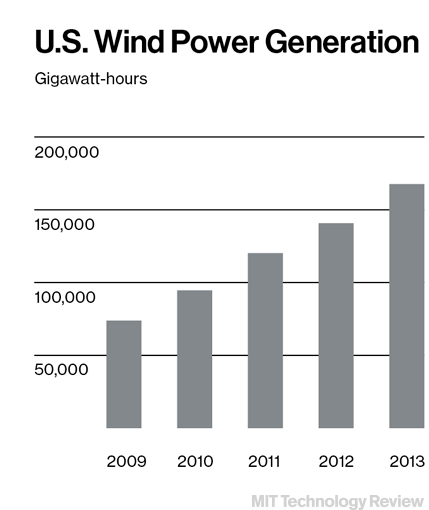
The amount of wind power has more than doubled since 2009.

The forecasts are helping power companies deal with one of the biggest challenges of wind power: its intermittency. Using small amounts of wind power is no problem for utilities. They are accustomed to dealing with variability—after all, demand for electricity changes from season to season, even from minute to minute. However, a utility that wants to use a lot of wind power needs backup power to protect against a sudden loss of wind. These backup plants, which typically burn fossil fuels, are expensive and dirty. But with more accurate forecasts, utilities can cut the amount of power that needs to be held in reserve, minimizing their role.

Before the forecasts were developed, Xcel Energy, which supplies much of Colorado’s power, ran ads opposing a proposal that it use renewable sources for a modest 10 percent of its power. It mailed flyers to its customers claiming that such a mandate would increase electricity costs by as much as $1.5 billion over 20 years.

But thanks in large part to the improved forecasts, Xcel, one of the country’s largest utilities, has made an about-face.

It has installed more wind power than any other U.S. utility and supports a mandate for utilities to get 30 percent of their energy from renewable sources, saying it can easily handle much more than that.

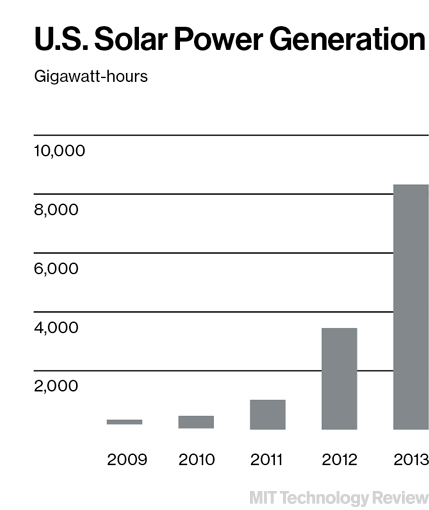
Solar power generation lags wind power production by about a decade.

An early version of NCAR’s forecasting system was released in 2009, but last year was a breakthrough year—accuracy improved significantly, and the forecasts saved Xcel nearly as much money as they had in the three previous years combined. This year NCAR is testing a similar forecasting system for solar power.

Mining these detailed forecasts to develop a more flexible and efficient electricity system could make it much cheaper to hit ambitious international goals for reducing carbon emissions, says Bryan Hannegan, director of a $135 million facility at the National Renewable Energy Laboratory (NREL) in Golden, Colorado, that uses supercomputer simulations to develop ways to scale up renewable power. “We’ve got a line of sight to where we want to go in the long term with our energy and environment goals,” he says. “That’s not something we’ve been able to say before.”

Chasing the Wind

No one is more aware of the challenges of integrating wind power into the grid than Dayton Jones, a power plant dispatcher for Xcel Energy. From his perch on the 10th floor of the Xcel building in downtown Denver, he’s responsible for keeping the lights on in Colorado. Doing so requires matching power production to electricity demand by turning power plants on and off and controlling their output. Generating too much or too little power can damage electrical appliances or even plunge the grid into a blackout. Wind power, with its sharp fluctuations, makes his job harder.

Running backup fossil-fuel plants means “throwing carbon up into the sky”: “It costs money, and it’s bad for the environment.”

A few years ago, dispatchers like Jones couldn’t trust forecasts of how much wind power would be available to the grid at a given time. Those forecasts were typically off by 20 percent, and sometimes wind power completely failed to materialize when predicted. The solution was to have fossil-fuel plants idling, ready to replace all of that wind power in a few minutes. This approach is expensive, and the more the system is intended to rely on wind power, the more expensive it gets. What’s more, running the backup fossil-fuel plants means you’re “throwing carbon up into the sky,” says William Mahoney, deputy director of the Research Applications Laboratory at NCAR. “It costs money, and it’s bad for the environment.”

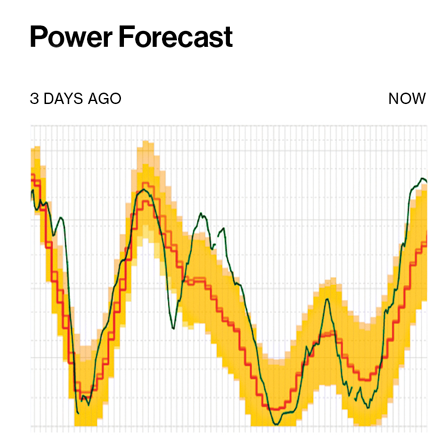
Actual power output (green line) is overlaid on a three-day wind power forecast (red line). The larger the yellow shaded area, the more uncertain the forecast.

NCAR’s forecasts give Jones enough confidence in wind power to shut down many of the idling backup plants. The number varies depending on the certainty of the forecast. If the weather is cold and wet and there’s a chance ice could form on wind turbines and slow them down or stop them from spinning, he might need enough fossil-fuel backup to completely replace his wind power.

But on nice days with steady, abundant wind, he might shut down all his fast-response backup plants, even those normally reserved for responding to changes in demand. Under such circumstances, Jones can use the wind farms themselves to ensure that power supply matches demand: the output of a wind turbine can be changed almost instantly by angling the blades so they capture more or less wind. Computers at Xcel’s building in Denver tell wind farms how much power to produce, and automated controls coördinate hundreds of turbines, changing output minute by minute if needed.

Xcel’s original forecasts used data from just one or two weather stations per wind farm. Now NCAR collects information from nearly every wind turbine. The data feeds into a high-resolution weather model and is combined with the output from five additional wind forecasts. Using historical data, NCAR’s software learns which forecasts are best for each wind farm and assigns different weights to each accordingly. The resulting über-forecast is more accurate than any of the original ones. Then, using data about how much power each turbine in the field will generate in response to different wind speeds, NCAR tells Xcel how much power to expect, in 15-minute increments, for up to seven days.

Forecasting solar power is next for NCAR and Xcel, but that can be even trickier than wind. For one thing, Xcel doesn’t get information about how much power private rooftop solar panels are generating, so it doesn’t know how much of that power it could lose when clouds roll in. NCAR’s new solar forecasts will use data from satellites, sky imagers, pollution monitors, and publicly owned solar panels to infer how much solar power is being generated and then predict how that amount will change.

Virtual Energy

How might extremely accurate wind and solar forecasts help us use enough renewable energy to reach climate goals of significantly reducing carbon dioxide emissions? Researchers at NREL’s new Energy Systems Integration Facility start by looking at how well wind and solar power can offset each other. To what extent, for example, can wind blowing at night make up for the lack of sunshine? But they are also looking at how to couple forecasts with smart dishwashers, water heaters, solar-panel inverters, water treatment plants, and electric-car chargers, not only to accommodate shifts in the wind but to ride out inevitable windless periods and weeks of cloudy weather without resorting to fossil fuels.

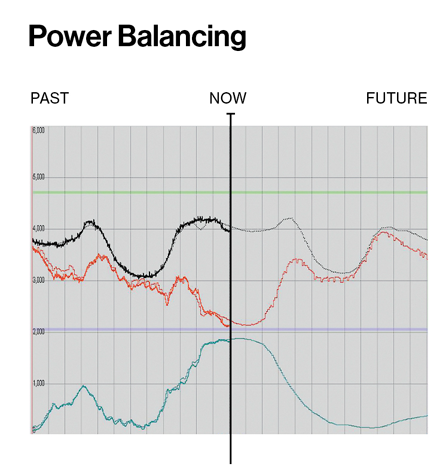
The red line—the result of subtracting wind power supply (blue) from demand (black)—shows the amount of power Xcel needs to generate with its fossil-fuel plants. The lighter lines are forecasts.

Take the example of electric cars. A car stores enough electricity to power a house for anywhere from half a day to several days, depending on the size of the battery pack. And it has sophisticated power electronics that can control the timing and vary the rate of charging, which could offer a way to match fluctuating wind power to electricity demand. With small modifications, the cars’ batteries can deliver stored power to a home and to the power grid. There aren’t many electric cars now, but that could easily change in the decades it will take before renewable energy makes up more than 30 or 40 percent of the electricity supply (wind supplies 4 percent now, and solar less than 1 percent).

At NREL, researchers can plug 30 electric cars into docks that let them interface with power-grid simulations on a supercomputer, to project what would happen if thousands of cars were connected to the grid. The idea is that electric cars might store power from solar panels and use it to power neighborhoods when electricity demand peaks in the evening, and then recharge their batteries using wind power in the early morning hours.

Forecasts like the ones being developed at NCAR will be “absolutely critical,” says Bri-Mathias Hodge, a senior research engineer at NREL. They will help determine when the cars’ batteries should charge to maximize the electricity they make available to the grid without leaving drivers short of the power they need.

Even before that becomes a reality, though, forecasts from NCAR are already having a big effect. Last year, on a windy weekend when power demand was low, Xcel set a record: during one hour, 60 percent of its electricity for Colorado was coming from the wind. “That kind of wind penetration would have given dispatchers a heart attack a few years ago,” says Drake Bartlett, who heads renewable-energy integration for Xcel. Back then, he notes, they wouldn’t have known whether they might suddenly lose all that power. “Now we’re taking it in stride,” he says. “And that record is going to fall.”

Kevin Bullis

Technology Review - La rivista del MIT per l'innovazione - Mozilla Firefox 2014-02-27 12.32.02