By Mayo Clinic Staff Cardiopulmonary resuscitation (CPR) is a lifesaving technique useful in many emergencies, including heart attack or near drowning, in which someone's breathing or heartbeat has stopped. The American Heart Association recommends that everyone — untrained bystanders and medical personnel alike — begin CPR with chest compressions. It's far better to do something than to do nothing at all if you're fearful that your knowledge or abilities aren't 100 percent complete. Remember, the difference between your doing something and doing nothing could be someone's life. Here's advice from the American Heart Association: - Untrained. If you're not trained in CPR, then provide hands-only CPR. That means uninterrupted chest compressions of about 100 a minute until paramedics arrive (described in more detail below). You don't need to try rescue breathing.
- Trained and ready to go. If you're well-trained and confident in your ability, begin with chest compressions instead of first checking the airway and doing rescue breathing. Start CPR with 30 chest compressions before checking the airway and giving rescue breaths.
- Trained but rusty. If you've previously received CPR training but you're not confident in your abilities, then just do chest compressions at a rate of about 100 a minute. (Details described below.)
The above advice applies to adults, children and infants needing CPR, but not newborns. CPR can keep oxygenated blood flowing to the brain and other vital organs until more definitive medical treatment can restore a normal heart rhythm. When the heart stops, the lack of oxygenated blood can cause brain damage in only a few minutes. A person may die within eight to 10 minutes. To learn CPR properly, take an accredited first-aid training course, including CPR and how to use an automated external defibrillator (AED). If you are untrained and have immediate access to a phone, call 911 before beginning CPR. The dispatcher can instruct you in the proper procedures until help arrives. Before you begin Before starting CPR, check: - Is the person conscious or unconscious?
- If the person appears unconscious, tap or shake his or her shoulder and ask loudly, "Are you OK?"
- If the person doesn't respond and two people are available, one should call 911 or the local emergency number and one should begin CPR. If you are alone and have immediate access to a telephone, call 911 before beginning CPR — unless you think the person has become unresponsive because of suffocation (such as from drowning). In this special case, begin CPR for one minute and then call 911 or the local emergency number.
- If an AED is immediately available, deliver one shock if instructed by the device, then begin CPR.
Remember to spell C-A-B The American Heart Association uses the acronym of CAB — compressions, airway, breathing — to help people remember the order to perform the steps of CPR. Compressions: Restore blood circulation - Put the person on his or her back on a firm surface.
- Kneel next to the person's neck and shoulders.
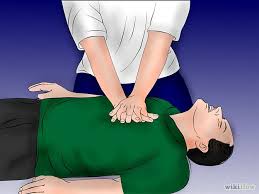
- Place the heel of one hand over the center of the person's chest, between the nipples. Place your other hand on top of the first hand. Keep your elbows straight and position your shoulders directly above your hands.
- Use your upper body weight (not just your arms) as you push straight down on (compress) the chest at least 2 inches (approximately 5 centimeters). Push hard at a rate of about 100 compressions a minute.
- If you haven't been trained in CPR, continue chest compressions until there are signs of movement or until emergency medical personnel take over. If you have been trained in CPR, go on to checking the airway and rescue breathing.
Airway: Clear the airway - If you're trained in CPR and you've performed 30 chest compressions, open the person's airway using the head-tilt, chin-lift maneuver. Put your palm on the person's forehead and gently tilt the head back. Then with the other hand, gently lift the chin forward to open the airway.
- Check for normal breathing, taking no more than five or 10 seconds. Look for chest motion, listen for normal breath sounds, and feel for the person's breath on your cheek and ear. Gasping is not considered to be normal breathing. If the person isn't breathing normally and you are trained in CPR, begin mouth-to-mouth breathing. If you believe the person is unconscious from a heart attack and you haven't been trained in emergency procedures, skip mouth-to-mouth breathing and continue chest compressions.
Breathing: Breathe for the person Rescue breathing can be mouth-to-mouth breathing or mouth-to-nose breathing if the mouth is seriously injured or can't be opened. - With the airway open (using the head-tilt, chin-lift maneuver), pinch the nostrils shut for mouth-to-mouth breathing and cover the person's mouth with yours, making a seal.
- Prepare to give two rescue breaths. Give the first rescue breath — lasting one second — and watch to see if the chest rises. If it does rise, give the second breath. If the chest doesn't rise, repeat the head-tilt, chin-lift maneuver and then give the second breath. Thirty chest compressions followed by two rescue breaths is considered one cycle.
- Resume chest compressions to restore circulation.
- If the person has not begun moving after five cycles (about two minutes) and an automated external defibrillator (AED) is available, apply it and follow the prompts. Administer one shock, then resume CPR — starting with chest compressions — for two more minutes before administering a second shock. If you're not trained to use an AED, a 911 or other emergency medical operator may be able to guide you in its use. If an AED isn't available, go to step 5 below.
- Continue CPR until there are signs of movement or emergency medical personnel take over.
To perform CPR on a child The procedure for giving CPR to a child age 1 through 8 is essentially the same as that for an adult. The differences are as follows: - If you're alone, perform five cycles of compressions and breaths on the child — this should take about two minutes — before calling 911 or your local emergency number or using an AED.
- Use only one hand to perform chest compressions.
- Breathe more gently.
- Use the same compression-breath rate as is used for adults: 30 compressions followed by two breaths. This is one cycle. Following the two breaths, immediately begin the next cycle of compressions and breaths.
- After five cycles (about two minutes) of CPR, if there is no response and an AED is available, apply it and follow the prompts. Use pediatric pads if available, for children ages 1 through 8. If pediatric pads aren't available, use adult pads. Do not use an AED for children younger than age 1. Administer one shock, then resume CPR — starting with chest compressions — for two more minutes before administering a second shock. If you're not trained to use an AED, a 911 or other emergency medical operator may be able to guide you in its use.
Continue until the child moves or help arrives. To perform CPR on a baby Most cardiac arrests in babies occur from lack of oxygen, such as from drowning or choking. If you know the baby has an airway obstruction, perform first aid for choking. If you don't know why the baby isn't breathing, perform CPR. To begin, examine the situation. Stroke the baby and watch for a response, such as movement, but don't shake the baby. If there's no response, follow the CAB procedures below and time the call for help as follows: - If you're the only rescuer and CPR is needed, do CPR for two minutes — about five cycles — before calling 911 or your local emergency number.
- If another person is available, have that person call for help immediately while you attend to the baby.
Compressions: Restore blood circulation - Place the baby on his or her back on a firm, flat surface, such as a table. The floor or ground also will do.
- Imagine a horizontal line drawn between the baby's nipples. Place two fingers of one hand just below this line, in the center of the chest.
- Gently compress the chest about 1.5 inches (about 4 centimeters).
- Count aloud as you pump in a fairly rapid rhythm. You should pump at a rate of 100 compressions a minute.
Airway: Clear the airway - After 30 compressions, gently tip the head back by lifting the chin with one hand and pushing down on the forehead with the other hand.
- In no more than 10 seconds, put your ear near the baby's mouth and check for breathing: Look for chest motion, listen for breath sounds, and feel for breath on your cheek and ear.
Breathing: Breathe for the baby - Cover the baby's mouth and nose with your mouth.
- Prepare to give two rescue breaths. Use the strength of your cheeks to deliver gentle puffs of air (instead of deep breaths from your lungs) to slowly breathe into the baby's mouth one time, taking one second for the breath. Watch to see if the baby's chest rises. If it does, give a second rescue breath. If the chest does not rise, repeat the head-tilt, chin-lift maneuver and then give the second breath.
- If the baby's chest still doesn't rise, examine the mouth to make sure no foreign material is inside. If an object is seen, sweep it out with your finger. If the airway seems blocked, perform first aid for a choking baby.
- Give two breaths after every 30 chest compressions.
- Perform CPR for about two minutes before calling for help unless someone else can make the call while you attend to the baby.
- Continue CPR until you see signs of life or until medical personnel arrive.
|
