quinta-feira, 4 de dezembro de 2014

Nanotube film could replace defective retinas


Damaged or defective retinas may someday be replaced by a nanotube film that transforms li...

Damaged or defective retinas may someday be replaced by a nanotube film that transforms light into electrical signals and thereby restores regular vision (Photo: Shutterstock)

A promising new study suggests that a wireless, light-sensitive, and flexible film could potentially form part of a prosthetic device to replace damaged or defective retinas. The film both absorbs light and stimulates neurons without being connected to any wires or external power sources, standing it apart from silicon-based devices used for the same purpose. It has so far been tested only on light-insensitive retinas from embryonic chicks, but the researchers hope to see the pioneering work soon reach real-world human application.

Some neurons are genetically-predisposed to be sensitive to light. An emerging field called optogenetics uses light to stimulate and control those neurons, with applications not only in vision but also in gene therapy, brain mapping, reducing pain sensitivity, treatment of neurological disorders such as epilepsy and Parkinson's disease, and even mind control.

The researchers sought to develop an optogenetics approach to restoring vision. They combined semiconductor nanorods and carbon nanotube film and found that the resultant system stimulated neurons in light-insensitive embryonic chicks at day 14 of their development when illuminated with violet light for 100 ms.

A carbon nanotube-semiconductor nanocrystal film attached to the retina stimulates neurons...

Most previously-tested artificial vision technologies are silicon based, with rigid, non-transparent photoconductive chips implanted (often invasively and with great complexity) into the subject and connected to an external power source. These older systems also suffer from long-term stability issues and low spatial resolution, the researchers note.

"We hope our carbon nanotube and semiconductor nanorod film will serve as a compact replacement for damaged retinas," said lead researcher Yael Hanein. His colleague Lilach Bareket cautions, however, that scientists are "still far away from actually replacing the damaged retina."

If the technology does prove viable for use in humans, we could see it applied in treatment of age-related macular degeneration, which currently affects as many as 15 million Americans, and in other retina-based vision problems – including many forms of blindness.

The research was conducted by an international team spread across Tel Aviv University, the Hebrew University of Jerusalem, and Newcastle University. A paper describing the work has been published in the journal Nano Letters.

Sources: The Hebrew University of Jerusalem, Tel Aviv University


Novel approach to treating asthma: Neutralize the trigger


Current asthma treatments can alleviate wheezing, coughing and other symptoms felt by millions of Americans every year, but they don't get to the root cause of the condition. Now, for the first time, scientists are reporting a new approach to defeating asthma by targeting the trigger -- the allergen -- before it can spark an attack. They describe their new compound, which they tested on rats, in ACS' Journal of Medicinal Chemistry.

Clive Robinson and colleagues explain that to prevent many health problems, the ideal approach to treatment or prevention involves getting to the cause of a condition and targeting it directly. Asthma, which occurs when the immune system goes into overdrive affecting the airway in response to an otherwise harmless substance, has posed a challenge to this model. That's because it can be set off by different allergens or irritants. But recent studies suggest that the picture might not be as complicated as previously thought. Scientists have found that dust mites are one of the most important triggers of allergic asthma. So Robinson's team wanted to find a way to neutralize mite allergens.

The researchers identified a compound that binds to a major dust mite allergen and turned it into an inhalable powder. They tested it on rats and found that it significantly dampened the animals' immune response when they were exposed to a variety of allergens. This compound and other similar inhibitors could hail a new direction in asthma treatment, say the researchers.

The authors acknowledge funding from the Wellcome Trust.


Story Source:

The above story is based on materials provided by American Chemical Society. Note: Materials may be edited for content and length.


Journal Reference:

  1. Gary K. Newton, Trevor R. Perrior, Kerry Jenkins, Meriel R. Major, Rebekah E. Key, Mark R. Stewart, Stuart Firth-Clark, Steven M. Lloyd, Jihui Zhang, Nicola J. Francis-Newton, Jonathan P. Richardson, Jie Chen, Pei Lai, David R. Garrod, Clive Robinson. The Discovery of Potent, Selective, and Reversible Inhibitors of the House Dust Mite Peptidase Allergen Der p 1: An Innovative Approach to the Treatment of Allergic Asthma. Journal of Medicinal Chemistry, 2014; 57 (22): 9447 DOI: 10.1021/jm501102h


quarta-feira, 3 de dezembro de 2014

Laser sniffs out toxic gases from afar: System can ID chemicals in atmosphere from a kilometer away


The new technology can discriminate one type of gas from another with greater specificity than most remote sensors -- even in complex mixtures of similar chemicals -- and under normal atmospheric pressure, something that wasn't thought possible before.

The researchers say the technique could be used to test for radioactive byproducts from nuclear accidents or arms control treaty violations, for example, or for remote monitoring of smokestacks or factories for signs of air pollution or chemical weapons.

"You could imagine setting this up around the perimeter of an area where soldiers are living, as a kind of trip wire for nerve gas," said lead author Henry Everitt, an Army scientist and adjunct professor of physics at Duke University.

The technique uses a form of invisible light called terahertz radiation, or T-rays.

Already used to detect tumors and screen airport passengers, T-rays fall between microwaves and infrared radiation on the electromagnetic spectrum.

Zapping a gas molecule with a terahertz beam of just the right energy makes the molecule switch between alternate rotational states, producing a characteristic absorption spectrum "fingerprint," like the lines of a bar code.

Terahertz sensors have been used for decades to identify trace gases in the dry, low-pressure conditions of interstellar space or in controlled conditions in the lab, where they are capable of unambiguous identification and ultra-sensitive, part-per-trillion detection.

But until now, efforts to use the same technique to detect trace gases under normal atmospheric conditions have failed because the pressure and water vapor in the air smears and weakens the spectral fingerprint.

In a study published in the journal Physical Review Applied, Everitt, Ohio State University physicist Frank De Lucia and colleagues have developed a way around this problem.

Their approach works by blasting a cloud of gas with two beams at once. One is a steady terahertz beam, tuned to the specific rotational transition energy of the gas molecule they're looking for.

The second beam comes from a laser, operating in the infrared, which emits light in high-speed pulses.

At the U.S. Army Aviation and Missile Research, Development, and Engineering Center near Huntsville, Alabama, the researchers have installed a one-of-a-kind infrared laser.

Manufactured by a company called STI Optronics, it's capable of firing dozens of pulses of infrared light a second, each of which is less than a billionth-of-a-second long.

"It's kind of like whacking a molecule with an infrared sledgehammer," Everitt said.

Normal atmospheric pressure still blurs the chemical "bar code" produced by the blast of the Terahertz beam, but the ultra-short pulses of light from the more powerful infrared laser knock the molecule out of equilibrium, causing the smeared absorption lines to flicker.

"We just have to tune each beam to the wavelengths that match the type of molecule we're looking for, and if we see a change, we know it has to be that gas and nothing else," Everitt said.

The researchers directed the two beams onto samples of methyl fluoride, methyl chloride and methyl bromide gases in the lab to determine what combination of laser settings would be required to detect trace amounts of these gases under different weather conditions.

"Terahertz waves will only propagate so far before water vapor in the air absorbs them, which means the approach works a lot better on, say, a cold winter day than a hot summer day," Everitt said.

The researchers say they are able to detect trace gases from up to one kilometer away. But even under ideal weather conditions, the technology isn't ready to be deployed in the field just yet.

For one, converting an eight-foot, one-ton laser into something closer in size to a briefcase will take some time.

Having demonstrated that the technique can work, their next step is to figure out how to tune the beams to detect additional gases.

Initially, they plan to focus on toxic industrial chemicals such as ammonia, carbon disulfide, nitric acid and sulfuric acid.

Eventually, the researchers say their technique could also be useful for law enforcement in detecting toxic gases generated by meth labs, and other situations where detection at the gas's source isn't feasible.

"Point sensing at close range is always better than remote sensing if you can do it, but it's not always possible. These methods let us collect chemical intelligence that tells us what's going on before we get somewhere," Everitt said.

The research was supported by grants from the Defense Threat Reduction Agency (DTRA) and the Defense Advanced Research Projects Agency (DARPA). Additional support was provided by the U.S. Army.

World’s fastest 2-D camera, 100 billion frames per second, may enable new scientific discoveries


Photographers have been pursuing the capture of transient scenes at a high imaging speed for centuries. Now, Washington University engineers have developed the world's fastest receive-only 2-D camera that can capture events up to 100 billion frames per second. This image is also the cover illustration of the Dec. 4, 2014, issue of Nature, in which Wang's research appears.

A team of biomedical engineers at Washington University in St. Louis, led by Lihong Wang, PhD, the Gene K. Beare Distinguished Professor of Biomedical Engineering, has developed the world's fastest receive-only 2-D camera, a device that can capture events up to 100 billion frames per second.

That's orders of magnitude faster than any current receive-only ultrafast imaging techniques, which are limited by on-chip storage and electronic readout speed to operations of about 10 million frames per second.

Using the Washington University technique, called compressed ultrafast photography (CUP), Wang and his colleagues have made movies of the images they took with single laser shots of four physical phenomena: laser pulse reflection, refraction, faster-than light propagation of what is called non-information, and photon racing in two media. While it's no day at the races, the images are entertaining, awe-inspiring and represent the opening of new vistas of scientific exploration.

The research appears in the Dec. 4, 2014, issue of Nature.

"For the first time, humans can see light pulses on the fly," Wang says. "Because this technique advances the imaging frame rate by orders of magnitude, we now enter a new regime to open up new visions. Each new technique, especially one of a quantum leap forward, is always followed a number of new discoveries. It's our hope that CUP will enable new discoveries in science -- ones that we can't even anticipate yet."

This camera doesn't look like a Kodak or Cannon; rather, it is a series of devices envisioned to work with high-powered microscopes and telescopes to capture dynamic natural and physical phenomena. Once the raw data are acquired, the actual images are formed on a personal computer; the technology is known as computational imaging.

The development of the technology was funded by two grants from the National Institutes of Health that support pioneering and potentially transformative approaches to major challenges in biomedical research.

"This is an exciting advance and the type of groundbreaking work that these high-risk NIH awards are designed to support," said Richard Conroy, PhD, program director of optical imaging at the National Institute of Biomedical Imaging and Bioengineering, part of the NIH. "These ultrafast cameras have the potential to greatly enhance our understanding of very fast biological interactions and chemical processes and allow us to build better models of complex, dynamical systems."

An immediate application is in biomedicine. One of the movies shows a green excitation light pulsing toward fluorescent molecules on the right where the green converts to red, which is the fluorescence. By tracking this, the researchers can get a single shot assessment of the fluorescence lifetime, which can be used to detect diseases or reflect cellular environmental conditions like pH or oxygen pressure.

Wang envisions applications in astronomy and forensics, where the advanced imaging frame rate could analyze the temporal activities of a supernova that occurred light years away, or track and predict the movements of thousands of potentially hazardous pieces of "space junk," refuse of old satellites and jettisoned space craft hurtling about at high speed in outer space. In forensics, CUP might be used in reproducing bullet pathways, which could once again open up the Kennedy assassination conspiracy theories and revive a more accurate analysis of the strange physics of the "magic bullet."

Wang and his collaborators essentially added components and used algorithms to complement an existing technology known as a streak camera, which measures the intensity variation in a pulse of light with time. While a streak camera is fast, it gives only a one-dimensional view, which "is not intuitive -- much analogous to watching a horse race through a distant vertical slit," Wang said. "We expanded the view into 2-D space, more like what we see in the real world."

CUP photographs an object with a specialty camera lens, which takes the photons from the object on a journey through a tube-like structure to a marvelous tiny apparatus called a digital micromirror device (DMD), smaller than a dime though hosting about 1 million micromirrors, each one just seven by seven microns squared. There, micromirrors are used to encode the image, then reflect the photons to a beam splitter which shoots the photons to the widened slit of a streak camera. The photons are converted to electrons, which are then sheared with the use of two electrodes, converting time to space. The electrodes apply a voltage that ramps from high to low, so the electrons will arrive at different times and land at different vertical positions. An instrument called a charge-coupled device (CCD) stores all the raw data. All of this occurs at the breathtaking pace of 5 nanoseconds. One nanosecond is a billionth of a second.

Wang's work with CUP pushes the dimensional limits of fundamental physics and also pushes the limits of deep imaging of biological tissues, one of Wang's research specialties.

"Fluorescence is an important aspect of biological technologies," he says. "We can use CUP to image the lifetimes of various fluorophores, including fluorescent proteins, at light speed."

In the astronomy world, CUP can be a game-changer, Wang says.

"Combine CUP imaging with the Hubble Telescope, and we will have both the sharpest spatial resolution of the Hubble and the highest temporal solution with CUP," he says. "That combination is bound to discover new science."

This research was funded by the National Institutes of Health grants DP1 EB016986 and R01 CA186567.

CO2 warming effects felt just a decade after emitted


Wed, 12/03/2014 - 10:54am

Institute of Physics

It takes just 10 years for a single emission of carbon dioxide to have its maximum warming effects on the Earth.

This is according to researchers at the Carnegie Institute for Science who have dispelled a common misconception that the main warming effects from a carbon dioxide emission will not be felt for several decades.

The results, which have been published in Environmental Research Letters, also confirm that warming can persist for more than a century and suggest that the benefits from emission reductions will be felt by those who have worked to curb the emissions and not just future generations.

Some of these benefits would be the avoidance of extreme weather events, such as droughts, heat waves and flooding, which are expected to increase concurrently with the change in temperature.

However, some of the bigger climate impacts from warming, such as sea-level rise, melting ice sheets and long-lasting damage to ecosystems, will have a much bigger time lag and may not occur for hundreds or thousands of years later, according to the researchers.

Lead author of the study Dr. Katharine Ricke said: “Amazingly, despite many decades of climate science, there has never been a study focused on how long it takes to feel the warming from a particular emission of carbon dioxide, taking carbon-climate uncertainties into consideration.

“A lot of climate scientists may have an intuition about how long it takes to feel the warming from a particular emission of carbon dioxide, but that intuition might be a little bit out of sync with our best estimates from today's climate and carbon cycle models.

To calculate this timeframe, Dr. Ricke, alongside Prof. Ken Caldeira, combined results from two climate modeling projects.

The researchers combined information about the Earth’s carbon cycle—specifically how quickly the ocean and biosphere took up a large pulse of carbon dioxide into the atmosphere—with information about the Earth’s climate system taken from a group of climate models used in the latest IPCC assessment.

The results showed that the median time between a single carbon dioxide emission and maximum warming was 10.1 years, and reaffirmed that most of the warming persists for more than a century.

The reason for this time lag is because the upper layers of the oceans take longer to heat up than the atmosphere. As the oceans take up more and more heat which causes the overall climate to warm up, the warming effects of carbon dioxide emissions actually begin to diminish as carbon dioxide is eventually removed from the atmosphere. It takes around 10 years for these two competing factors to cancel each other out and for warming to be at a maximum.

“Our results show that people alive today are very likely to benefit from emissions avoided today and that these will not accrue solely to impact future generations,” Dr. Ricke continued.

"Our findings should dislodge previous misconceptions about this timeframe that have played a key part in the failure to reach policy consensus.”

Source: Institute of Physics

Brain Training Doesn’t Make You Smarter


Scientists doubt claims from brain training companies

December 2, 2014 By David Z. Hambrick

If you’ve spent more than about 5 minutes surfing the web, listening to the radio, or watching TV in the past few years, you will know that cognitive training—better known as “brain training”—is one of the hottest new trends in self improvement. Lumosity, which offers web-based tasks designed to improve cognitive abilities such as memory and attention, boasts 50 million subscribers and advertises on National Public Radio. Cogmed claims to be “a computer-based solution for attention problems caused by poor working memory,” and BrainHQ will help you “make the most of your unique brain.” The promise of all of these products, implied or explicit, is that brain training can make you smarter—and make your life better.

Yet, according to a statement released by the Stanford University Center on Longevity and the Berlin Max Planck Institute for Human Development, there is no solid scientific evidence to back up this promise. Signed by 70 of the world’s leading cognitive psychologists and neuroscientists, the statement minces no words:

"The strong consensus of this group is that the scientific literature does not support claims that the use of software-based “brain games” alters neural functioning in ways that improve general cognitive performance in everyday life, or prevent cognitive slowing and brain disease."

The statement also cautions that although some brain training companies “present lists of credentialed scientific consultants and keep registries of scientific studies pertinent to cognitive training…the cited research is [often] only tangentially related to the scientific claims of the company, and to the games they sell.”

This is bad news for the brain training industry, but it isn’t surprising. Little more than a decade ago, the consensus in psychology was that a person’s intelligence, though not fixed like height, isn’t easily increased. This consensus reflected a long history of failure. Psychologists had been trying to come up with ways to increase intelligence for more than a century, with little success. The consistent finding from this research was that when people practice some task, they get better on that task, and maybe on very similar tasks, but not on other tasks. Play a videogame and you’ll get better at that videogame, and maybe at very similar videogames, the research said, but you won’t get better at real-world tasks like doing your job, driving a car, or filling out your tax return.

What’s more, whenever intelligence gains were reported, they were modest, especially given how much training it took to produce them. In a University of North Carolina study known as the Abecedarian Early Intervention Project, low-income children received intensive intervention from infancy to age 5 that included educational games, while children in a control group received social services, health care and nutritional supplements. At the end of the study, all of the children were given at IQ test, and the average was about 6 points higher for the treatment group than the control group—in statistical terms, a medium size effect. 

Thinking about the modifiability of intelligence started to change in the 2000s. A major impetus was a 2008 study led by Susanne Jaeggi—then a postdoctoral researcher at the University of Michigan and now a professor at the University of California Irvine—and published in the Proceedings of the National Academy of Sciences. Jaeggi and colleagues had a sample of young adults complete a test of reasoning ability to assess “fluid” intelligence—the ability to solve novel problems. The participants were then assigned to either a control group, or to a treatment group in which they practiced a computerized task called “dual n-back,” which requires a person to monitor two streams of information—one auditory and one visual. (The task is challenging, to put it mildly.) Finally, all of the participants took a different version of the reasoning test to see whether the training had any impact on fluid intelligence.

The results were striking. Not only did the training group show more improvement in the reasoning test than the control group, the gain was large enough to have an impact on people’s lives. As John Jonides, the senior University of Michigan scientist on the research team, explained, there was also a dosage-dependent relationship: “Our discovery is that 4 weeks or so of training will produce a noticeable difference in fluid intelligence…We’ve also shown that the longer you train short-term memory, the more improvement you get in IQ.”

The study made a splash. Once published, most studies are cited in the scientific literature no more than a few times, if they are ever cited at all. The Jaeggi study has now been cited over 800 times—an astonishing number for a study published just six years ago. Discover magazine called the findings one of the top 100 scientific discoveries of 2008, and the psychologist Robert Sternberg—author of more than 1,500 publications on intelligence—declared that the study seemed to “to resolve the debate over whether fluid intelligence is, in at least some meaningful measure, trainable.”

Not everyone was convinced. In fact, not long after it was published, the Jaeggi study was No. 1 on a list of the top twenty studies that psychologists would like to see replicated. Above all, what gave the skeptics pause was the magnitude of the reported gain in intelligence—it seemed larger than possible. Studies like the Abecedarian Early Intervention Project had shown that it takes years of intensive intervention to increase IQ by a few points. Jaeggi and colleagues’ findings implied a 6 point increase in just a few hours.

The study had serious flaws, too, making the results difficult to interpret. One problem was that there was no placebo control group—no group that received training in a task that was not expected to increase intelligence (analogous to people in the placebo group of a drug study taking a sugar pill). Instead, the control group was a “no-contact” group, meaning that the people simply took the reasoning test two times, and had no contact with the researchers in between. Therefore, the possibility that the treatment group got better on the reasoning test just because they expected that they would get better could not be ruled out. Further complicating matters, the reasoning test differed across training groups; some of the participants got a 10-minute test, while others got a 20-minute test. Finally, Jaeggi and colleagues only used one test to see whether intelligence improved. Showing that people are better on one reasoning test after training doesn’t mean they’re smarter—it means they’re better at one reasoning test.

With all of this in mind, my colleagues and I set out to replicate Jaeggi and colleagues’ findings. First, we gave people 17 different cognitive ability tests, including 8 tests of fluid intelligence. We then assigned a third of the participants to a treatment group in which they practiced the dual n-back task, a third to a placebo control group in which they practiced another task, and the remaining third to a no-contact control group. Finally, at the end of the study, we gave everyone different versions of the cognitive ability tests. The results were clear: the dual n-back group was no higher in fluid intelligence than the control groups. Not long after we published these results, another group of researchers published a second failure to replicate Jaeggi and colleagues’ findings.

A meta-analysis cast further doubt on the effectiveness of brain training. Synthesizing the results of 23 studies, researchers Monica Melby-Lervåg and Charles Hulme found no evidence that brain training improves fluid intelligence. (A meta-analysis aggregates the results of multiple studies to arrive at more precise estimates of statistical relationships—in this case, the relationship between training and improvement in intelligence.) Jaeggi and colleagues have since published their own meta-analysis, and have come to the slightly more optimistic conclusion that brain training can increase IQ by 3 to 4 points. However, in the best studies in this meta-analysis—those that included a placebo control group—the effect of training was negligible.

In another highly publicized study, published last year in Nature, a team of researchers led by University of California San Francisco professor and entrepreneur Adam Gazzaley gave a sample of older adults training in a custom videogame called Neuroracer. The theory behind Neuroracer was originally proposed by the cognitive psychologists Lynn Hasher and Rose Zacks. In a series of articles, Hasher and Zacks argued that a major cause of what we now call “senior moments”—forgetfulness, inattentiveness, and other mental lapses—is mental “clutter.” That is, as we get older, we are more easily distracted by things in the outside world, and by irrelevant thoughts. Neuroracer is designed to strengthen the ability to filter out distraction. The player’s goal is to steer a car on a windy road with one hand, while using the other hand to shoot down signs of a particular color and shape, ignoring other signs.

Gazzaley and colleagues gave older adults tests of memory, attention, and other cognitive abilities before and after they practiced either Neuroracer or a control task over a 4 week period to assess transfer of training—in other words, to see whether there were any benefits of playing Neuroracer. Not surprisingly, people got better in Neuroracer. In fact, after practicing, the older adults improved to the level of a 20-year old in the game. Moreover, the researchers claimed that there was evidence that playing Neuroracer mitigated effects of aging on certain cognitive functions. But there were problems with this study, too. One critique raised no fewer than 19 concerns about the results and methods. Compared to the placebo group, the training group showed more improvement from pre-test to post-test for only 3 of the 11 transfer measures. Also, the sample size was small, meaning that even these hints of effectiveness may not replicate, and nearly a quarter of the people in the study were dropped from the statistical analyses. Finally, there was no demonstration that the Neuroracer training made people better in real-world tasks. These concerns notwithstanding, with investment from pharmaceutical companies Pfizer and Shire, Gazzaley and colleagues have applied for FDA approval of a new game based on Neuroracer. The goal, as Gazzaley explained in a recent presentation, is for the game to “become the world’s first prescribed videogame.”  

The bottom line is that there is no solid evidence that commercial brain games improve general cognitive abilities. But isn’t it better to go on brain training with the hope, if not the expectation, that scientists will someday discover that it has far-reaching benefits? The answer is no. Scientists have already identified activities that improve cognitive functioning, and time spent on brain training is time that you could spend on these other things. One is physical exercise. In a long series of studies, University of Illinois psychologist Arthur Kramer has convincingly demonstrated that aerobic exercise improves cognitive functioning. The other activity is simply learning new things. Fluid intelligence is hard to change, but “crystallized” intelligence—a person’s knowledge and skills—is not. Learn how to play the piano or cook a new dish, and you have increased your crystallized intelligence. Of course, brain training isn’t free, either. According to one projection, people will spend $1.3 billion on brain training in 2014.

It is too soon to tell whether there are any benefits of brain training. Perhaps there are certain skills that people can learn through brain training that are useful in real life. For example, University of Alabama Birmingham psychologist Karleen Ball and her colleagues have shown that a measure called “useful field of view”—the region of space over which a person can attend to information—can be improved through training and correlates with driving performance. What is clear, though, is that brain training is no magic bullet, and that extraordinary claims of quick gains in intelligence are almost certainly wrong. As the statement from the scientific community on the brain training industry concluded, “much more research is needed before firm conclusions [on brain training] can be drawn.” Until then, time and money spent on brain training is, as likely as not, time and money wasted. 

Biology of anxious temperament may lie with a problem in an anxiety 'off switch'


December 2, 2014

Elsevier

Persistent anxiety is one of the most common and distressing symptoms compromising mental health. Most of the research on the neurobiology of anxiety has focused on the generation of increased anxiety, i.e., the processes that “turn on” anxiety. But what if the problem lay with the “off switch” instead? In other words, the dysfunction could exist in the ability to diminish anxiety once it has begun. A new report suggests that deficits in one of the brain’s off switches for anxiety, neuropeptide Y receptors, are decreased in association with anxious temperament.


Persistent anxiety is one of the most common and distressing symptoms compromising mental health. Most of the research on the neurobiology of anxiety has focused on the generation of increased anxiety, i.e., the processes that "turn on" anxiety.

But what if the problem lay with the "off switch" instead? In other words, the dysfunction could exist in the ability to diminish anxiety once it has begun.

A new report in the current issue of Biological Psychiatry by researchers at the University of Wisconsin at Madison suggests that deficits in one of the brain's off switches for anxiety, neuropeptide Y receptors, are decreased in association with anxious temperament.

To conduct their work, the researchers studied 24 young rhesus monkeys to examine expression of the neuropeptide Y system in relation to anxious temperament. Neuropeptide Y is a neurotransmitter that helps regulate the body's response to stress. Anxious temperament is a trait that presents early in life and increases the risk of developing anxiety and depressive disorders.

They found that elevated anxious temperament is associated with decreased messenger RNA expression of two neuropeptide Y receptors, Y1R and Y5R, in the central nucleus of the amygdala, a region of the brain that plays an important role in regulating fear and anxiety.

"This finding is very important as it focuses our thinking about treatment on promoting recovery after stress rather than suppressing the normal adaptive reaction to threatening situations. Fear, at times, is the best possible reaction to life events. However, persistent fear can be destructive. This new finding points us in the direction of new treatments that aim to promote resilience rather than blunting one's life experiences," said Dr. John Krystal, Editor of Biological Psychiatry.

The authors agree, with first author Dr. Patrick Roseboom noting that "extreme anxiety in children is a prominent predictor of the later development of anxiety disorders and other illnesses such as depression and substance abuse. Using young rhesus monkeys in our model of anxious temperament is critical as brain structure and function in non-human primates closely resembles that of humans."

"Identifying the molecular underpinnings of why some individuals are at-risk for developing anxiety and depression has the potential to identify new treatment targets," added Roseboom. "The current findings suggest that focusing on a system that provides resilience may be an important strategy at the molecular level."


Story Source:

The above story is based on materials provided by Elsevier. Note: Materials may be edited for content and length.


Journal Reference:

  1. Patrick H. Roseboom, Steven A. Nanda, Andrew S. Fox, Jonathan A. Oler, Alexander J. Shackman, Steven E. Shelton, Richard J. Davidson, Ned H. Kalin. Neuropeptide Y Receptor Gene Expression in the Primate Amygdala Predicts Anxious Temperament and Brain Metabolism. Biological Psychiatry, 2014; 76 (11): 850 DOI: 10.1016/j.biopsych.2013.11.012


Why don't children belong to the clean plate club?


Whereas most adults are members of the Clean Plate Club, they eat an average of about 90% of the food they serve themselves, children do not.

New Cornell research aggregated six different studies of 326 elementary school-aged children. It showed that, if their parents are not around, the average child only eats about 60% of what they serve themselves. More than a third goes right in the trash.

Unlike adults, kids are still learning about what foods they like and how much it will take to fill them up. "It's natural, for them to make some mistakes and take a food they don't like or to serve too much," says lead researcher Brian Wansink, author of Slim by Design: Mindless Eating Solutions for Everyday Life and Director of the Cornell Food and Brand Lab. "What's less natural is for them to be forced to eat their 'mistakes' by their parents."

"Yet to a loving, but frustrated parent who wants his/her non-cooperating children to be vegetable-eating members of the Clean Plate Club, there is good news in these results. They show that children who only eat half to two-thirds of the food they serve themselves aren't being wasteful, belligerent, or disrespectful," said Wansink, "They are just being normal children." This should provide comfort and reduce anxiety for frustrated Clean Plate Club parents.


Story Source:

The above story is based on materials provided by Cornell Food & Brand Lab. Note: Materials may be edited for content and length.


Journal Reference:

  1. Wansink, Brian and Katherine A. Johnson. Adults Only: Why Don't Children Belong to the Clean Plate Club? International Journal of Obesity, 2014 (in press)


Filtro de madeira remove 99% das bactérias da água


3,4 milhões de pessoas morrem todos os anos devido a doenças relacionadas com água, saneamento e higiene.

Há várias tecnologias que podem ajudar a acabar com esta terrível estatística, no entanto, a maioria exige investimento e algum tipo de infra-estrutura de distribuição.

Uma equipe de investigadores do MIT acredita que pode ter descoberto uma nova solução: a madeira.

wood water filter madeira filtro água mit

Os cientistas tentaram filtrar água contaminada, usando pouco mais que um ramo partido de uma árvore e um tubo de plástico. O resultado foi surpreendente: o ramo conseguiu filtrar 99% das bactérias presentes na amostra de água contaminada.

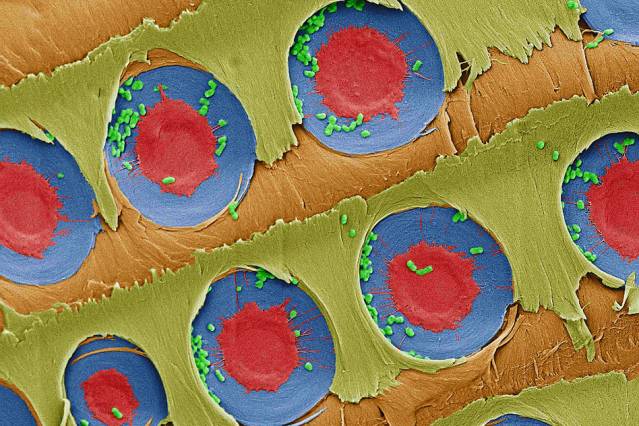
O ramo funciona como um filtro, concentrando as bactérias prejudiciais à saúde humana nas próprias células da madeira. Como se pode ver na fotografia:

mit água portável madeira filtro

Imagem do microscópio eletrónico (cores falsas) mostram bactérias E. coli (verde claro) presas nas células da planta (vermelho e azul) no ramo após a filtração.

Este sistema de filtração de tecnologia simples pode produzir até quatro litros de água potável por dia. Os investigadores estão agora a estudar o potencial de outras plantas que apresentam efeitos semelhantes.

Apesar da excelente notícia, o filtro de madeira não consegue absorver vírus, que são muito mais pequenos que as bactérias.

Fonte: MIT News


Losing air: Barrage of small impacts likely erased much of the Earth’s primordial atmosphere


Today's atmosphere likely bears little trace of its primordial self: Geochemical evidence suggests that Earth's atmosphere may have been completely obliterated at least twice since its formation more than 4 billion years ago.

Today's atmosphere likely bears little trace of its primordial self: Geochemical evidence suggests that Earth's atmosphere may have been completely obliterated at least twice since its formation more than 4 billion years ago. However, it's unclear what interplanetary forces could have driven such a dramatic loss.

Now researchers at MIT, Hebrew University, and Caltech have landed on a likely scenario: A relentless blitz of small space rocks, or planetesimals, may have bombarded Earth around the time the moon was formed, kicking up clouds of gas with enough force to permanently eject small portions of the atmosphere into space.

Tens of thousands of such small impacts, the researchers calculate, could efficiently jettison Earth's entire primordial atmosphere. Such impacts may have also blasted other planets, and even peeled away the atmospheres of Venus and Mars.

In fact, the researchers found that small planetesimals may be much more effective than giant impactors in driving atmospheric loss. Based on their calculations, it would take a giant impact -- almost as massive as Earth slamming into itself -- to disperse most of the atmosphere. But taken together, many small impacts would have the same effect, at a tiny fraction of the mass.

Hilke Schlichting, an assistant professor in MIT's Department of Earth, Atmospheric and Planetary Sciences, says understanding the drivers of Earth's ancient atmosphere may help scientists to identify the early planetary conditions that encouraged life to form.

"[This finding] sets a very different initial condition for what the early Earth's atmosphere was most likely like," Schlichting says. "It gives us a new starting point for trying to understand what was the composition of the atmosphere, and what were the conditions for developing life."

Schlichting and her colleagues have published their results in the journal Icarus.

Efficient ejection

The group examined how much atmosphere was retained and lost following impacts with giant, Mars-sized and larger bodies and with smaller impactors measuring 25 kilometers or less -- space rocks equivalent to those whizzing around the asteroid belt today.

The team performed numerical analyses, calculating the force generated by a given impacting mass at a certain velocity, and the resulting loss of atmospheric gases. A collision with an impactor as massive as Mars, the researchers found, would generate a shockwave through Earth's interior, setting off significant ground motion -- similar to simultaneous giant earthquakes around the planet -- whose force would ripple out into the atmosphere, a process that could potentially eject a significant fraction, if not all, of the planet's atmosphere.

However, if such a giant collision occurred, it should also melt everything within the planet, turning its interior into a homogenous slurry. Given the diversity of noble gases like helium-3 deep inside Earth today, the researchers concluded that it is unlikely that such a giant, core-melting impact occurred.

Instead, the team calculated the effects of much smaller impactors on Earth's atmosphere. Such space rocks, upon impact, would generate an explosion of sorts, releasing a plume of debris and gas. The largest of these impactors would be forceful enough to eject all gas from the atmosphere immediately above the impact's tangent plane -- the line perpendicular to the impactor's trajectory. Only a fraction of this atmosphere would be lost following smaller impacts.

To completely eject all of Earth's atmosphere, the team estimated, the planet would need to have been bombarded by tens of thousands of small impactors -- a scenario that likely did occur 4.5 billion years ago, during a time when the moon was formed. This period was one of galactic chaos, as hundreds of thousands of space rocks whirled around the solar system, frequently colliding to form the planets, the moon, and other bodies.

"For sure, we did have all these smaller impactors back then," Schlichting says. "One small impact cannot get rid of most of the atmosphere, but collectively, they're much more efficient than giant impacts, and could easily eject all the Earth's atmosphere."

Runaway effect

However, Schlichting realized that the sum effect of small impacts may be too efficient at driving atmospheric loss. Other scientists have measured the atmospheric composition of Earth compared with Venus and Mars. These measurements have revealed that while each planetary atmosphere has similar patterns of noble gas abundance, the budget for Venus is similar to that of chondrites -- stony meteorites that are primordial leftovers of the early solar system. Compared with Venus, Earth's noble gas budget has been depleted 100-fold.

Schlichting realized that if both planets were exposed to the same blitz of small impactors, Venus' atmosphere should have been similarly depleted. She and her colleagues went back over the small-impactor scenario, examining the effects of atmospheric loss in more detail, to try and account for the difference between the two planets' atmospheres.

Based on further calculations, the team identified an interesting effect: Once half a planet's atmosphere has been lost, it becomes much easier for small impactors to eject the rest of the gas. The researchers calculated that Venus' atmosphere would only have to start out slightly more massive than Earth's in order for small impactors to erode the first half of the Earth's atmosphere, while keeping Venus' intact. From that point, Schlichting describes the phenomenon as a "runaway process -- once you manage to get rid of the first half, the second half is even easier."

Time zero

During the course of the group's research, an inevitable question arose: What eventually replaced Earth's atmosphere? Upon further calculations, Schlichting and her team found the same impactors that ejected gas also may have introduced new gases, or volatiles.

"When an impact happens, it melts the planetesimal, and its volatiles can go into the atmosphere," Schlichting says. "They not only can deplete, but replenish part of the atmosphere."

The group calculated the amount of volatiles that may be released by a rock of a given composition and mass, and found that a significant portion of the atmosphere may have been replenished by the impact of tens of thousands of space rocks.

"Our numbers are realistic, given what we know about the volatile content of the different rocks we have," Schlichting notes.

Jay Melosh, a professor of earth, atmospheric, and planetary sciences at Purdue University, says Schlichting's conclusion is a surprising one, as most scientists have assumed Earth's atmosphere was obliterated by a single, giant impact. Other theories, he says, invoke a strong flux of ultraviolet radiation from the sun, as well as an "unusually active solar wind."

"How the Earth lost its primordial atmosphere has been a longstanding problem, and this paper goes a long way toward solving this enigma," says Melosh, who did not contribute to the research. "Life got started on Earth about this time, and so answering the question about how the atmosphere was lost tells us about what might have kicked off the origin of life."

Going forward, Schlichting hopes to examine more closely the conditions underlying Earth's early formation, including the interplay between the release of volatiles from small impactors and from Earth's ancient magma ocean.

"We want to connect these geophysical processes to determine what was the most likely composition of the atmosphere at time zero, when the Earth just formed, and hopefully identify conditions for the evolution of life," Schlichting says.