sábado, 15 de novembro de 2014

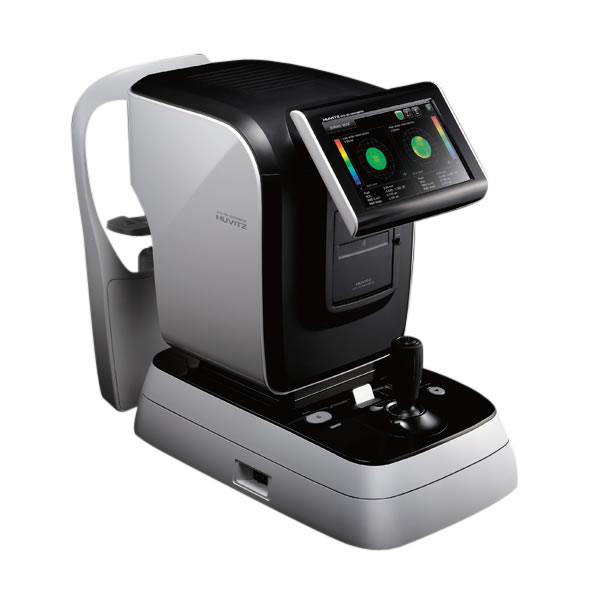
HRK8000 A Auto Ref-Keratometer


HRK8000 A Auto Ref-Keratometer


Name:
HRK8000 A Auto Ref-Keratometer
Serial Number: HRK8000 A

Manufacturer Name:
HUVITZ ( FOR EXPORT ONLY )

HRK8000 A - Autorefractor Keratometer

Extreme Precision & Accuracy !

Most Advanced Wavefront Technology

High Order Aberrometry Data Output Opens Possbilities for High Market trended customized lens applications.

Wavefront Technology measures the wavefront of light reflected from the retina and the refractive power with various sensors divided by sectors and analyzes them with extreme precision.

Micro Lens Array

Huvitz’ own developed Micro Lens Array creates a number of separated focal spots, of which the pattern provides valuable information of the customer’s ocular system.

Customized Lens Manufacturing

High order aberration and Zernike map data output function allow premium custom spectacle or contact lens manufacturers to improves vision accuracy and power.

High order aberration data such as Coma, Trefoil, Spherical Aberration, Secondary Astigmatism, and Tetrafoil, which was only available in wavefront aberrometers, now is available in Huvitz HRK-8000A! Clinical usage of this data is all in your hands!

Besides the conventional data such as Spherical, Cylinder and Axis, the high order aberration data is displayed in a graphical Zernike refraction map for better understanding of patient’s eyes and superior clinical decision making. Besides the conventional data such as Spherical, Cylinder and Axis, the high order aberration data is displayed in a graphical Zernike refraction map for better understanding of patient’s eyes and superior clinical decision making.

Point Spread Function (PSF) and chart simulation of retinal display can make patients understood in a much better way of their clinical status of eyes and customized lens benefits.

The World's First Contact Fitting Guides and Recommendations.

The Full Color CCD camera and white LED light source in the auto refkeratometer enable you to see eyes and contact lens fitting status which was previously only possible with slit lamps.

HRK-8000A provides peripheral keratometry measurement data that can be greatly useful for fitting contact lenses.

The World’s First contact lens fitting function in an auto ref-keratometer enables you to see fluorescein liquid with blue illumination. The HRK-8000A also analyzes and simulates the lens fitting status with automatic calculation and recommendation.

Contact Lens Prescription Guide

Image capture and contrast regulation is possible. The HRK-8000A gives you the best On-K fitting guide based on the base curve and KER value measured!

Ultra High Precision KER Data

Mire ring and LED sources enable highly reliable keratometry data of the corneal base curve to be obtained.

Unmatched Performance & Speed Provides Comfortable User Enviroment.

High brightness and contrast VGA 7” wide color TFT LCD screen provides with high resolution video images. Smooth and free tilting function also offers you a comfortable and clear view at any angle.

Auto Tracking

The cutting edge auto sensor and 3 dimensional movement mechanism enables you to track down a measuring focus of an eye automatically and complete the measurement perfectly even with an inexperienced user.

In case a measuring point is out of auto tracking range, the animated guide on the screen suggests how to operate the joystick in the easiest and most intuitive way.

Vision Comparison Function

The internal chart provides a vision comparison function of current vision and corrected vision.

Just by pressing the Up & Down buttons, users can set the height of the measuring point comfortably and quickly

Faster Measurement Speed

Faster measurement speed than any other competitors’ equipment!

Comfortable One Touch Lock

The upper moving stage can be locked easily with the one touch button, making locking smooth and easy.

Automatic paper cutting and one touch paper roll change functions are new advantages of the HRK-8000A.

Ext. Monitor & Network Connectivity

Full HD video output through the HDMI port provides a differentiated explanation base for clinical consulting with your patients. HRK-8000A supports network connectivity with Huvitz Digital Refraction System enabling easy and fast refraction in networking.

Unlike many conventional diagnostic devices, HRK-8000A is based on Hartmann-Shack wavefront sensor, which analyzes many focal spots of a light wavefront.

It has the ability to measure not just the basic refraction error of a customer, but to obtain a spatially resolved refraction map. The new HRK-8000A utilizes a unique wavefront analysis algorithm and surpasses conventional and simple refraction offering added values with high order aberration data output for customized lenses and observation of patients before and after refractive surgery. Experience the whole new wavefront Auto Ref Keratometer form

Huvitz, HRK-8000A!

Image showing the Huvitz HRK8000 A connected to an external monitor (optional)

SPECIFICATIONS

MEASUREMENT MODE

K/R Mode Continuous Keratometry & Refractometry

REF Mode Refractometry

KER Mode Keratometry

CLBC Mode Contact Lens Base Curve Measurement

KER P Mode Peripheral Keratometry

Color View Mode Color View & Contact Lens Fitting Assistance

(White & Blue LED Light)

REFRACTOMETRY

Vertex Distanc(VD) 0.0, 12.0, 13.5, 15.0

Sphere(SPH) -30.00~+25.00 (VD=12mm)

(Increments: 0.01, 0.12, 0.25D)

Cylinder(CYL) 0.0012.00D (Increments 0.01, 0.12, 0.25D)

CLBC Mode 1~180( Increments:1

Cylinder Form -, +,

Pupil Distance 10~85mm

Minimum Pupil Diameter 2.0mm

KERATOMETRY

Radius of Curvature 5.0~13.0mm (Increments: 0.01mm)

Corneal Power 25.96~67.50D

(When corneal equivalent refractive index is 1.3375)

(Increments:0.05, 0.12, 0.25D)

Corneal Astigmatism 0.00~-15.00D (Increments:0.05, 0.12, 0.25D)

Axis 0~180(Increments:1

Pupil, Iris Diameter 2.0~14.0mm (Increments:0.1mm)

Memory of Data 10 measurements for each eye

MOVEMENT RANGE

Up-Down

Left-Right

Forward-Backward

OTHERS

Display 7 inch Wide Color TFT LCD,

Touch panel with Tilting function

Internal Printer Thermal Line Printer with Auto Cutting function

Power Saving Automatic switch-off(5min)

Power Supply AC100-240V, 50/60Hz(Free Voltage), 60W

Dimension/ Weight 262(W) x 518(D) x 441(H)mm / 20.9kg

Desings and details can be changed without prior notice for improvements.

www.deviceoptical.com

Snap 2014-11-15 at 15.38.46

Up close with the extraordinary Rolls-Royce Ghost Series II


Rolls Royce Ghost Series II (Photo: Loz Blain/Gizmag.com)

Rolls Royce Ghost Series II (Photo: Loz Blain/Gizmag.com)

Image Gallery (35 images)

Ultra-luxury brand Rolls-Royce has updated its "entry level" model with the release of the Ghost Series II. Targeted at a younger, entrepreneurial market, and more of a driver's car than a chauffeur's, the new Ghost gets a subtle facelift, an upgraded interior and a more affordable price tag, even if you're still talking the kind of dollars that would get you a nice bit of real estate. Technology-wise, the Ghost receives a number of updates, including headlights that automatically adjust so your high beams don't dazzle oncoming drivers, and a GPS-aided transmission that reads the road ahead and pre-selects the best gear for an upcoming hill or corner. Gizmag spoke to Sven Ritter, General Manager of Asia Pacific, about the new car, the brand's record setting sales run and the reasons why only high-altitude bulls get to donate their leather to a Rolls-Royce interior.

We'll leave others to comment on the updated Ghost II design; its newly elevated hood gives it a more muscular and powerful stance than the Series I, but the difference is understated. You're still looking at the same, gigantic V12 twin turbo engine, the same coach-style back doors and the same "who's in there?" presence on the road.

Rolls Royce Ghost Series II (Photo: Loz Blain/Gizmag.com)

Further thought has also gone into the interior, with redesigned seats that now include extendable thigh supports, as well as in-built heating and cooling for the discerning derriere. The rear seats are now slightly closer together, and angled intimately toward one another so occupants can look each other in the eye as they finalize bajillion-dollar deals.

The seat leather is stunning in its own right – and not by accident either, according to General Manager of Asia Pacific Sven Ritter: "When you come to Rolls-Royce in Goodwood in the UK, we have a huge leather shop. We source our own leather, we make our own seats. It's part of the craftsmanship we're really proud of. The leather is sourced from Northern Europe, where we have a special supplier who keeps their bulls above a certain height, I think it's 1000 meters, because there's no mosquitoes, or barbed wire fences up there, so the chances of damage to the leather is a lot less. The quality is sensational."

Rolls Royce Ghost Series II: updated seats

The massively powerful 12-cylinder engine delivers a refined ride; massive strength and immediate acceleration at all times, but without a raw or sporty feel: "We say in Rolls-Royce, it's a completely effortless experience," says Ritter. "Yes you have amazing power with a V12 twin turbo engine, 6.6 liter, 563 brake horsepower, 780 Newton-meter torque from 1500 rpm onwards. So you have power available all the time, and just effortless. You don't really hear much of the engine unless you really floor it. It's a magic carpet ride, especially with the Series II's updated suspension. It's as if you float over the road."

Aiding that effortless feel is a new GPS-aided transmission feature previously only seen on the "sportier" Wraith that reads the road ahead and selects gears before you know you need them. "Basically through GPS, it knows what corner or hill is coming up," says Ritter, "and it preselects the right gear to guide you through the corner in the most effortless way. You notice it more on B-roads, cornering roads, rather than around town."

Likewise the new headlights, whose daytime running lights make them one of the most obvious visual highlights of the makeover. They feature new technology designed to relieve the driver of the tiresome responsibility of dipping one's headlights to oncoming traffic. The adaptive LED high beams can spot oncoming traffic, and dim just the section of the high beam that would blind an oncoming car; you can leave the brights on at all times without dazzling other road users.

Rolls Royce Ghost Series II front grille and new headlight (Photo: Loz Blain/Gizmag.com)

Rolls Royce Ghost Series II: driver's view and HUD

From the driver's seat, the dash is mirrored up onto a reflected heads-up display on the window, that also includes navigation and phone control information to keep the driver's eye from having to wander down toward the 10.25-inch high-definition screen in the dash. That screen's where you'll find your multimedia controls, navigation system, infra-red night vision and heat cameras, top-down parking assist and onboard wi-fi controls, among other things.

Rolls Royce Ghost Series II: 10.25' high-def screen

Rather than smudge the screen with fingerprints by using a touch interface, the Ghost II features a "Spirit of Ecstasy" rotary touch pad control in the center console. Without lifting an arm, you can cycle through and choose options using the rotary control, press it down like a button, or use it as a touchpad to scroll, pinch to zoom and manipulate, or navigate through the system's many options. You can even trace a letter onto the top of the dial, which the car will recognize if you're going through an alphabetical list.

Rolls Royce Ghost Series II: centre console and rotating touch dial

Voice control is expanded as well, the press release hilariously suggesting "call Giles" as a sample command. What happened to Jeeves?

Music and other audio is delivered through a new sound system designed specifically for the Ghost Series II. "It's an 18-speaker bespoke sound system," Ritter tells us, "which we developed with in-house engineers and also specialist engineers from the audio industry. We didn't take a system off the shelf, we created a Rolls-Royce system. It's a fantastic system. It's the best you can have."

While you can "absolutely" walk into a store and drive away with a showroom Roller, Ritter feels you'd be missing out on an essential part of the Rolls-Royce experience if you did. "Globally more than 95 percent of Rolls Royces sold have some kind of bespoke feature, whether it's coachline, or leather, monograms, color schemes … We can create a new color finish if a customer gives us his wife's favorite nail varnish."

He points out a wall full of leather samples, which includes a lurid creamy pink that Ritter has seen implemented in at least two bespoke Rollers. It prompts me to ask whether there are limits of taste involved – is there a point at which Rolls-Royce would refuse to build something? "We can look at every option and see if it's feasible," Ritter smiles, "It's up to the customer's imagination. Most of the requests, we would fulfill."

Rolls Royce Ghost Series II (Photo: Loz Blain/Gizmag.com)

The car is full of gorgeous touches that make it a pleasure to ride in, from the touchless trunk that opens with a swing of the foot, to the doors, which gently but firmly close themselves once they're close enough. There's a touch button to close the rear doors so you can do so without leaning forward to grab a handle like some sort of animal, and the rearward opening coach doors do make for a lovely and dignified way to step in and out of the car. "It comes down to effortless entry and exit," says Ritter, "It's also to give more privacy. You step out, and you're hidden by the door. You can adjust your clothing while standing up before you leave the car." Presumably before the photographers have a chance to snap you.

Rolls Royce Ghost Series II. Photo: Loz Blain

In Australia, the price of the Ghost II has been slashed by some AU$90,000 so that you can now buy your first Roller for less than the Melbourne median house price. But it still starts at AU$545,000 on the road, and that's before you start specifying lime green leather or recycled teak wood inlay.

Despite the fact that 2014 is shaping up to be Rolls-Royce's fifth record-setting sales year in a row, and growth has been at least double-digits in every market around the globe, there's no mistaking that this is an incredibly exclusive vehicle. Only 3,630 Rollers were sold in total last year, and the brand will never be interested in mass manufacture.

So this is likely to be your correspondent's first and last chance to take a seat in one – note how I've tastefully hidden my bug-crusted motorcycle boots in behind the front seat. Decorum, folks, this is how one does it. Onward, Jeeves, lay a gumboot into it old chap!

Gizmag's Loz Blain reclines in comfort (Photo: Loz Blain/Gizmag.com)

Share

Pesquisadores brasileiros deselvolvem feijão resistente à sêca.


Feijão resistente à sêca


BBdNfFT

Fonte: msn notícias

Three win medicine Nobel for discovering brain's GPS


Tue, 10/07/2014 - 9:28am

Karl Ritter and Jill Lawless, Associated Press


Joint winner of the Nobel Prize for Physiology or Medicine professor John O'Keefe, a dual U.S. and British citizen, stands next to a chalkboard at the end of an interview with The Associated Press in an office he uses at the University College London, in London, Monday, Oct. 6, 2014. The U.S.-British scientist and a Norwegian husband-and-wife research team won the Nobel Prize in medicine Monday for discovering the brain's navigation system, a revelation that one day could help those with Alzheimer's. AP Photo/Matt Dunham

Joint winner of the Nobel Prize for Physiology or Medicine professor John O'Keefe, a dual U.S. and British citizen, stands next to a chalkboard at the end of an interview with The Associated Press in an office he uses at the University College London, in London, Monday, Oct. 6, 2014. The U.S.-British scientist and a Norwegian husband-and-wife research team won the Nobel Prize in medicine Monday for discovering the brain's navigation system, a revelation that one day could help those with Alzheimer's. AP Photo/Matt DunhamA U.S.-British scientist and a Norwegian husband-and-wife research team won the Nobel Prize in medicine Monday for discovering the brain's navigation system—the inner GPS that helps us find our way in the world—a revelation that could lead to advances in diagnosing Alzheimer's.

The research by John O'Keefe, May-Britt Moser and Edvard Moser represents a "paradigm shift" in neuroscience that could help researchers understand the sometimes severe spatial memory loss associated with Alzheimer's disease, the Nobel Assembly said.

"This year's Nobel Laureates have discovered a positioning system, an 'inner GPS' in the brain, that makes it possible to orient ourselves in space," the assembly said.

O'Keefe, 74, a dual U.S. and British citizen at the University College London, discovered the first component of this system in 1971 when he found that a certain type of nerve cell was always activated when a rat was at a certain place in a room. He demonstrated that these place cells were building up a map of the environment, not just registering visual input.

Thirty-four years later, in 2005, May-Britt Moser and Edvard Moser, married neuroscientists at the Norwegian University of Science and Technology in Trondheim, identified another type of nerve cell—the grid cell—that generates a coordinate system for precise positioning and path-finding, the assembly said.

Monday's award was the fourth time that a married couple has shared a Nobel Prize and the second time in the medicine category.

"This is crazy," an excited May-Britt Moser, 51, told The Associated Press by telephone from Trondheim.

"This is such a great honor for all of us and all the people who have worked with us and supported us," she said. "We are going to continue and hopefully do even more groundbreaking work in the future."

Her 52-year-old husband didn't immediately find out about the prize because he was flying to the Max Planck Institute in Munich, Germany, to demonstrate their research. Edvard Moser told the Norwegian news agency NTB he only discovered he had won after he landed in Munich, turned on his cellphone and saw a flood of emails, text messages and missed calls.

"I didn't know anything. When I got off the plane there was a representative there with a bouquet of flowers who said 'congratulations on the prize,'" he was quoted as saying.

The Nobel Assembly said the discoveries marked a shift in scientists' understanding of how specialized cells work together to perform complex cognitive tasks. They have also opened new avenues for understanding cognitive functions such as memory, thinking and planning.

"Thanks to our grid and place cells, we don't have to walk around with a map to find our way each time we visit a city, because we have that map in our head," said Juleen Zierath, chair of the medicine prize committee. "I think, without these cells, we would have a really hard time to survive."

O'Keefe told the AP he was working at home when his office called to say "there's a gentleman from Sweden who wants to have a word with you."

"Before I called him, I took a long, deep breath," O'Keefe said, speaking at his office at University College London.

O'Keefe was born in Harlem and raised in the South Bronx. "If you can survive the South Bronx, you can survive anything," he said.

He moved to England for postdoctoral training and found the place cells in a part of the brain called the hippocampus. The Mosers, meanwhile, identified the grid cells in a nearby section of the brain known as the entorhinal cortex.

O'Keefe said his work could be used as a basis for investigating Alzheimer's, for example, by designing tests to try to pick up the first signs of the disease.

"So we can not only use brain imaging to see the earliest signs of the disease in this part of the brain, but we can begin to see how it is affecting their memory, particularly their spatial memory," he said.

David Foster, a neuroscientist who studies place cells at Johns Hopkins University in Baltimore, said O'Keefe's discovery of place cells was controversial in 1971 but became widely accepted over the next few decades as more researchers began to study it.

"He founded the field," Foster said.

All three Nobel laureates won Columbia University's Louisa Gross Horwitz Prize last year for their discoveries. They will split the Nobel prize money of 8 million Swedish kronor (about $1.1 million), with half to O'Keefe and the other half to the Mosers.

The Nobel awards in physics, chemistry, literature and peace will be announced later this week and the economics prize will be announced next Monday. Created by Swedish industrialist Alfred Nobel, theNobel Prizes were first awarded in 1901. The winners collect their awards on Dec. 10, the anniversary ofNobel's death in 1896.

Last year's medicine award went to researchers who discovered how substances are transported within cells, a process involved in such important activities as brain cell communication and the release of insulin.

2014 Nobel Prize in Medicine: Details about the winners

Multispectral Sensors


PIXELTEQ has introduced new PixelSensor multispectral sensors. Thee multispectral sensors use on-chip filtering to pack eight wavelength-selective photodiodes onto an array measuring less than 1 cm, enabling simpler and smaller OEM optical devices. PixelCam and SpectraCam spectral cameras image spectral bands in UV, visible and NIR, as well as SWIR, for many applications.

PIXELTEQ, www.pixelteq.com


Thermal Imaging Camera


Thu, 04/10/2014 - 9:42am


FLIR Systems has introduced an enhanced version of its T650sc thermal imaging camera. Engineered for R&D the FLIR T650sc combines high accuracy (+/- 1 C) and sensitivity to routinely deliver accurate measurement of temperature differences (less than 20 mK).

The FLIR T650sc measures temperature of up to 2,000 C and includes a 5 Megapixel digital camera to provide clear visual images that may be overlaid with your IR data. With real-time radiometric recording in the camera, it is possible to capture fast events on the camera’s SD card for further analysis by the supplied analysis software. A new highly intuitive touchscreen user interface facilitates productive use of the T650sc with a minimum of training. The camera combines excellent ergonomics and feature-rich flexibility with superior image quality of 640 by 480 pixel Infrared resolution. The T650sc camera is equipped with FLIR's Multi Spectral Dynamic Imaging (MSX) feature.

FLIR Systems, www.flir.com


Industrial Measuring Microscope


Tue, 10/28/2014 - 12:23pm


Olympus Corp. has recently announced the launch of the new STM7 measuring microscope, an industrial microscope system designed for highly accurate measurement of machined parts, semiconductors, electronic components, and other processed industrial materials.

A measuring microscope series that combines high-performance Olympus optics with today’s most advanced measurement capabilities, the STM7 is available as both a manual Z-axis model and a motorized Z-axis model, each with a variety of stage options. Designed for highly efficient inspection and enhanced productivity, the STM7’s large square stage (up to 300 x 300 mm) can accommodate a number of variously shaped samples at the same time. The STM7 makes it possible to measure large samples such as printed circuit boards or semiconductor wafers with no shift in orientation.

To ensure measurement accuracy and ongoing reliability, the STM7 features a highly durable, vibration-resistant frame with a granite surface plate. As a result of this stability, part size, assembly, and other measurements can be taken at sub-micron levels with minimal error. When coupled with Olympus’ proven optical technology, this exceptionally stable frame assembly enables vivid high-resolution imaging of extremely minute samples.

The STM7 uses the same UIS2 infinity-corrected observation system harnessed by the industry’s most powerful optical microscopes. As a result, brightfield, darkfield, DIC, and POL images can all be observed with high resolution and high contrast, with aberration thoroughly eliminated. This ensures highly accurate measurement of even the smallest component details.

When used with STM7-BSW measurement support software and an Olympus microscope digital camera, the STM7 can perform accurate measurements of highly complex shapes while keeping system operation extremely simple. Measurement results can then be easily exported to Excel, facilitating fast, simple report generation and management.

Olympus IMS

Coordinate Measuring Machine


Zeiss Industrial Metrology has announced the latest generation of the successful Zeiss Contura is now entering the market. Zeiss is officially introducing the coordinate measuring machine at the CONTROL show in Stuttgart, Germany, beginning May 6, 2014. This system provides a platform for flexible, reliable and uncompromising quality assurance. It is even more precise than its predecessor and offers a large package of optical sensors on top of additional measuring ranges. Outstanding scanning technology, Zeiss Calypso reference software and a highly tuned overall system enable Zeiss Contura to maintain its place as the standard in its class.

Like no other Zeiss coordinate measuring machine, Zeiss Contura has made high-performance measuring technology available to the masses. The latest generation will continue on this proven path. A reliable measuring system is the result of the interaction of its components: design, sensors, software and service.

Thanks to its robust design, Zeiss Contura can also be used near production. The latest and most powerful scanning sensors from Zeiss are available for the machine.

Tailored sensors

In tune with the various customer requirements, sensors are available in the direkt, RDS and aktiv versions. With the Zeiss Vast XXT probe, the direkt model enables scanning. This configuration is ideal for small workpieces, for which a small single or star stylus is sufficient. Scanning makes it possible to efficiently and precisely measure the form in addition to the size and location. For parts with different angular positions, the RDS sensor model is the right choice. The RDS articulating probe holder can be freely positioned in 2.5 degree increments, resulting in more than 20,000 possible positions. Thanks to the RDS-CAA, the data from every single position can be mathematically calculated in just a few minutes. This drastically improves the utilization level of the machine and results in additional possibilities to immediately measure even complex angular positions. Its sensor interface permits the flexible use of contact and optical sensors, including the new Zeiss LineScan sensor. It enables the fast optical measurement of features.

The aktiv configuration is recommended when long styli are needed for measurements deep inside a part or for additional demands on precision and speed. The Zeiss Vast XTR gold and Vast XT gold premium probes are available. This active regulation enables highly accurate measurements with very long, heavy stylus systems.

Choice of measuring ranges

Another new feature is the range of measuring volumes. The Zeiss Contura family has eight different sizes starting with a measuring volume of 700 x 700 x 600 mm up to 1200 x 2400 x 1000 millimeters. From a design standpoint, Zeiss Contura is based on proven features: its efficient, highly precise air bearings are an in-house development. Zeiss AirSaver can also be integrated for additional savings. This technology reduces compressed air consumption by up to 60 percent depending on how it is used.

Zeiss Industrial Metrology

Raspberry Pi Model A+ brings smaller build, even lower price tag


The new board is the smallest and cheapest Raspberry Pi ever

The new board is the smallest and cheapest Raspberry Pi ever


The Raspberry Pi Foundation has today announced the latest version of its popular mini-computer. Known as the Model A+, the new system brings improvements introduced with the Model B+, while slimming down both the size and price tag of the board.

The most striking difference between the older Raspberry Pi boards and the new model is its size. The new version cuts the mini-computer’s length down from 86 mm (3.4 in) to just 65 mm (2.6 in). Like the Model B+, the new release makes use of microSD storage over full-size cards, and a low-noise power supply for better integrated audio.

It also carries over the same, larger GPIO header, with 40 pins compared to the 26 found on the original board, allowing for compatibility with the company’s HAT standard for add-on boards. Like the original Model A, the A+ only features a single USB port, meaning you’ll have to pick up a USB hub if you’re intending to plug multiple devices into the tiny computer, and there’s no Ethernet port on board. There is a plus side to those omissions, with the new model using less power than the original Model A.

The Model A+ measures just 65 mm (2.6 in) in length

In light of those changes, it’s clear that the Model A+ is designed to sit alongside existing B+ rather than serve as an outright replacement for older boards. The latest Pi packs the same 700 MHz Broadcom BCM2835 SoC as the Model B+, and offers 256 MB RAM, meaning that its small form-factor and low-powered nature are its biggest draws.

Aside from the even tinier build, the biggest headline here is the price tag. Raspberry Pi boards have never been expensive pieces of kit, but the new version is the most affordable yet, lowering the asking price to just US$20. The refreshed mini-computer is built in the same South Wales Sony factory as the Model B+, and is available for purchase today from MCM in the US and Farnell in the UK, where it retails for £20.

Source: Raspberry Pi Foundation

Share

Standalone Burg smartwatch lets you call and text from your wrist


The Burg lets users place calls, send messages and more, right from their wrist

The Burg lets users place calls, send messages and more, right from their wrist


The Burg 12 smartwatch from lifestyle designer Hermen van den Burg allows users to make phone calls, send messages and more, without the need to connect the device to a smartphone.

With wearable technology gaining some momentum in 2014, we’ve seen a wide range of smartwatches. While devices like the Asus ZenWatch have square displays, others, most notably the Moto 360, opted for a circular display instead. The Burg 12 attempts to combine the two concepts, putting a square display inside a circular dial. While the resulting aesthetic isn’t quite as disagreeable as the Epic wearable that we saw back in September, it’s far from our favourite smartwatch design.

Looks aside, the display here clocks in at 1.5-inches with a 240 x 240 resolution, giving it 226 pixels per inch. There’s 4 GB storage on board alongside a microSD reader, letting users expand storage up to 16 GB.

The watch runs its own proprietary software (usually not an encouraging sign), and gives the user access to call and text functionality without the need to pair it with a smartphone. The standalone abilities extend to calendar, calculator, MP3/MP4 player and radio functionality, and there’s even a camera on board (with an undisclosed resolution), allowing users to take, view and send snaps from their wrists.

The watch runs on custom software, and gives the user access to call and text functionalit...

The device ships with a US$25 prepaid SIM card. Interestingly, the standalone Burg 12 can also connect to any iPhone or Android smartphone, though it isn’t clear what added benefit this brings.

Standalone functionality isn’t a brand new concept for smartwatches – Samsung’s Gear S allows the user to place calls, send messages and even browse the web while a paired Galaxy phone sits at home.

The Burg 12 doesn’t appear to be nearly as refined a product as Samsung’s device, but it does have one thing going for it: price. The smartwatch is available now from Walmart, shipping for US$199 (just remember that you'll need to pay for its own line after that prepaid SIM bottoms out). It’s available in black and purple, and comes with black and purple straps, with additional interchangeable straps and bezels available.

Source: Burg Wearables

Share